
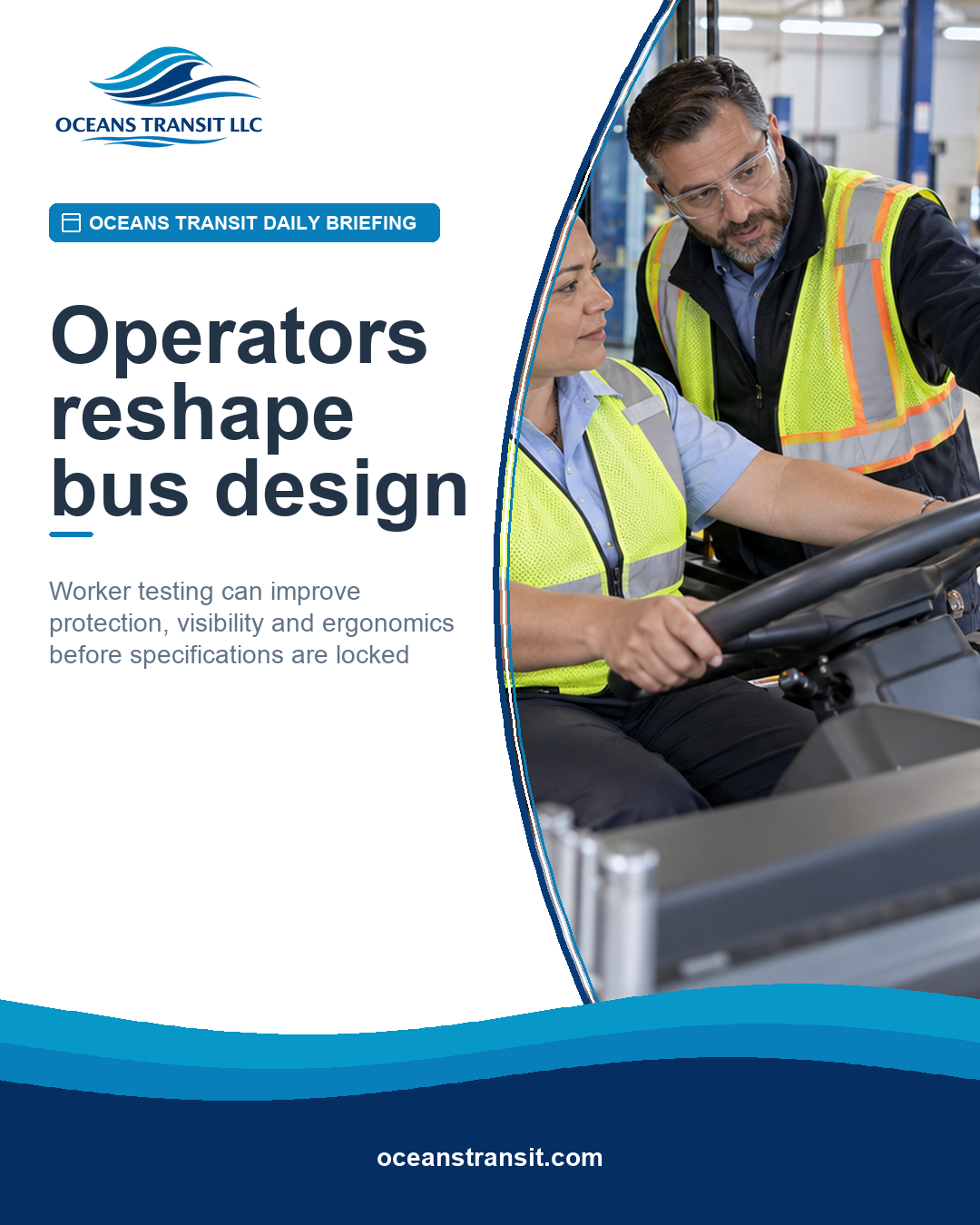
A bus operator's workstation is where vehicle design, human performance and public safety meet. On October 22, the Amalgamated Transit Union convened nearly 200 union leaders, transit agencies, manufacturers, transportation organizations and academic participants in Toronto for a Bus Safety and Innovation Summit focused on that space.
The agenda described by ATU included fully enclosed operator workstations, blind-spot reduction, air flow and ergonomic seating. Those questions affect what an operator can see, how controls can be reached, exposure to assaults and illness, and physical strain.
From consultation to applied design
The Toronto Transit Commission says it created its Bus Design Innovation Program with ATU International and ATU Local 113 in 2023. The first features it identifies—a semi-active operator seat, camera mirror systems and variations of operator barriers—came from ATU suggestions. TTC says lessons will inform future bus designs.
No single feature should be treated as an automatic improvement. A barrier may reduce exposure but introduce reflections or emergency-egress concerns. A camera mirror may improve one sight line while adding display placement, latency or glare issues. The right question is whether the full workstation supports safe performance across operators, routes, lighting, weather and emergency tasks.
Maintenance participation is essential because protection and reliability are linked. Training staff can identify whether a new control changes the operator's scan pattern, while procurement can translate accepted observations into measurable requirements. Agencies should preserve differing operator responses because route geometry, clothing, mobility or cab configuration may explain why a feature helps one group and burdens another.
An Oceans Transit design standard
- Define the operating task. Identify what the operator must see, reach, hear or do.
- Use representative operators. Include different body dimensions, experience and service assignments.
- Test realistic scenarios. Include motion, lighting, passenger interaction and emergencies where safely possible.
- Log unintended effects. Do not let one improvement create another hazard.
- Close the loop. Explain what changed, what did not and why, then verify the revision.
This is an Oceans Transit recommendation, not a federal mandate. It reflects a basic safety principle: people closest to the work can reveal conditions that drawings and specifications miss.
What to watch next
The summit shows broad interest in worker-centered bus design. The meaningful results will be documented tests, procurement requirements, field performance and shared lessons. Collaboration becomes operational safety when worker observations change a specification and the revised feature is verified.