
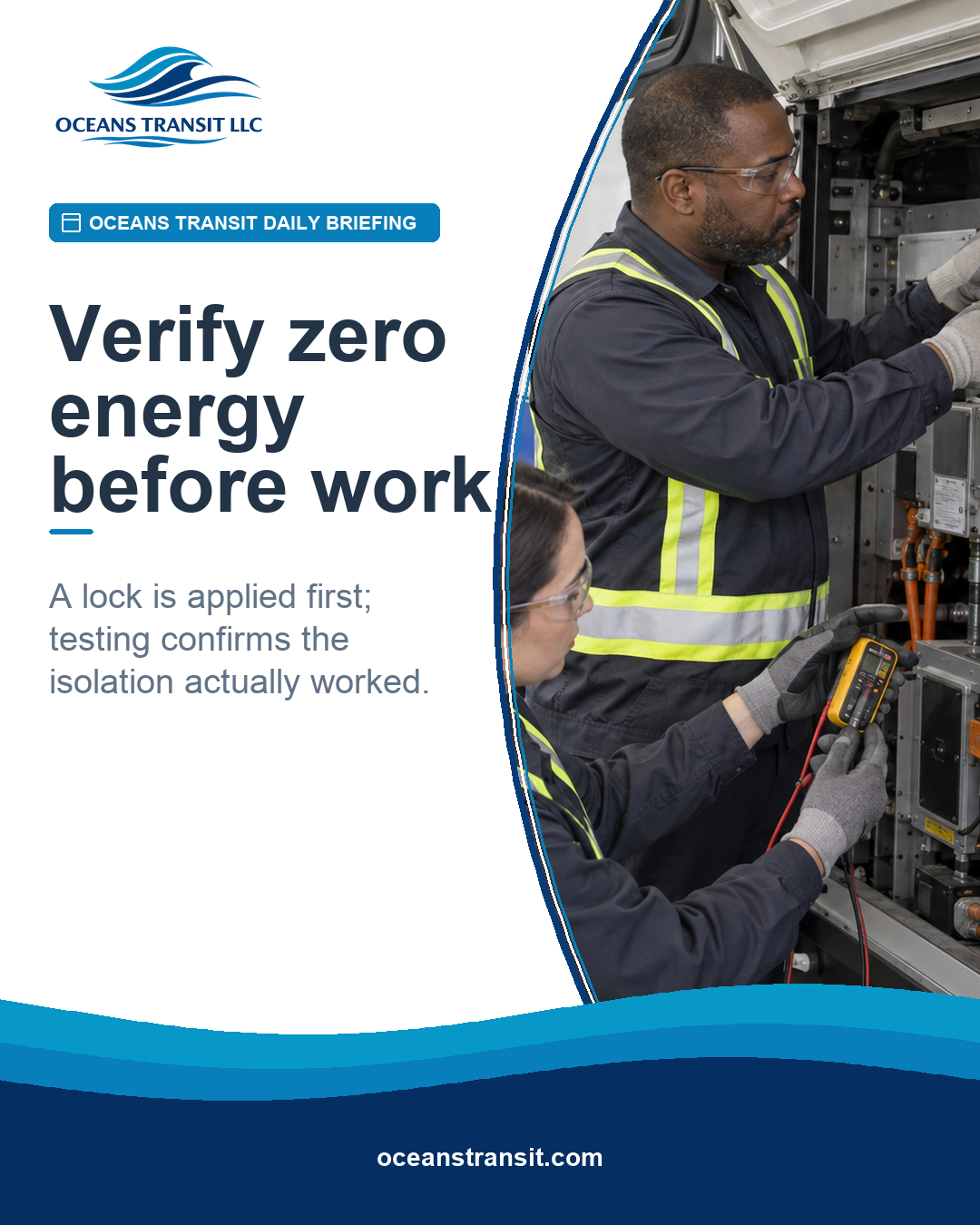
A lock and tag show intent. Before servicing begins, the authorized employee must verify that isolation and deenergization actually worked.
Transit maintenance exposes workers to more than electrical power. A bus or shop machine can hold mechanical, hydraulic, pneumatic, thermal, chemical or stored electrical energy. Shutting down from an operator control does not necessarily isolate those sources.
The Occupational Safety and Health Administration's control of hazardous energy standard requires employers to establish and use energy-control procedures for covered servicing and maintenance. The procedure must include specific steps for shutdown, isolation, blocking and securing, and specific requirements for testing the effectiveness of energy-control measures.
Verification is a required step
Under 29 CFR 1910.147(d)(6), the authorized employee must verify isolation and deenergization before work begins. Section 1910.147(d)(5) also requires potentially hazardous stored or residual energy to be relieved, disconnected, restrained or otherwise rendered safe. Where dangerous energy can reaccumulate, verification continues until the work is complete or that possibility no longer exists.
Those are OSHA requirements. The transit-specific teaching method below is an Oceans Transit recommendation for making the requirement observable; it does not replace the employer's machine-specific procedure or qualified electrical-safety rules.
Teach three separate actions
Oceans Transit recommends that instructors and supervisors distinguish three actions during a demonstration:
- Isolate: use the equipment-specific procedure to separate every identified energy source.
- Control: apply the required personal lockout or tagout devices and render stored energy safe.
- Verify: use the approved test or try method to confirm that the controls worked before exposure begins.
The learner should name each energy source and point to the isolating device. A push button, selector switch or software screen is not an energy-isolating device under the OSHA definition.
Use the right verification method
The verification method depends on the hazard and the employer's procedure. It may include an attempt to operate normal controls after ensuring personnel are clear, an approved electrical test by a qualified person, a pressure reading, blocking verification or another equipment-specific check.
For electrical testing, agencies must follow all applicable electrical-safety requirements, test-instrument practices and qualification limits. No employee should improvise a test or open guarded equipment merely to complete a training checklist.
Watch the handoffs
Contractor work, group lockout and shift changes create extra points of failure. OSHA requires on-site and outside employers to inform each other of their procedures for covered contractor work. Group and shift-transfer arrangements must preserve equivalent personal protection.
Oceans Transit recommends that the work record identify who owns the isolation, who independently verified it when the procedure calls for that, and how control transfers without leaving a gap.
Assess the behavior, not the vocabulary
A competent learner should be able to select the correct procedure, identify all energy sources, isolate and control them in sequence, manage stored energy, perform the approved verification, and explain what would cause the work to stop.
The observable standard is not “the lock is on.” It is “the authorized employee proved the equipment was isolated and safe for the task before servicing began.”