
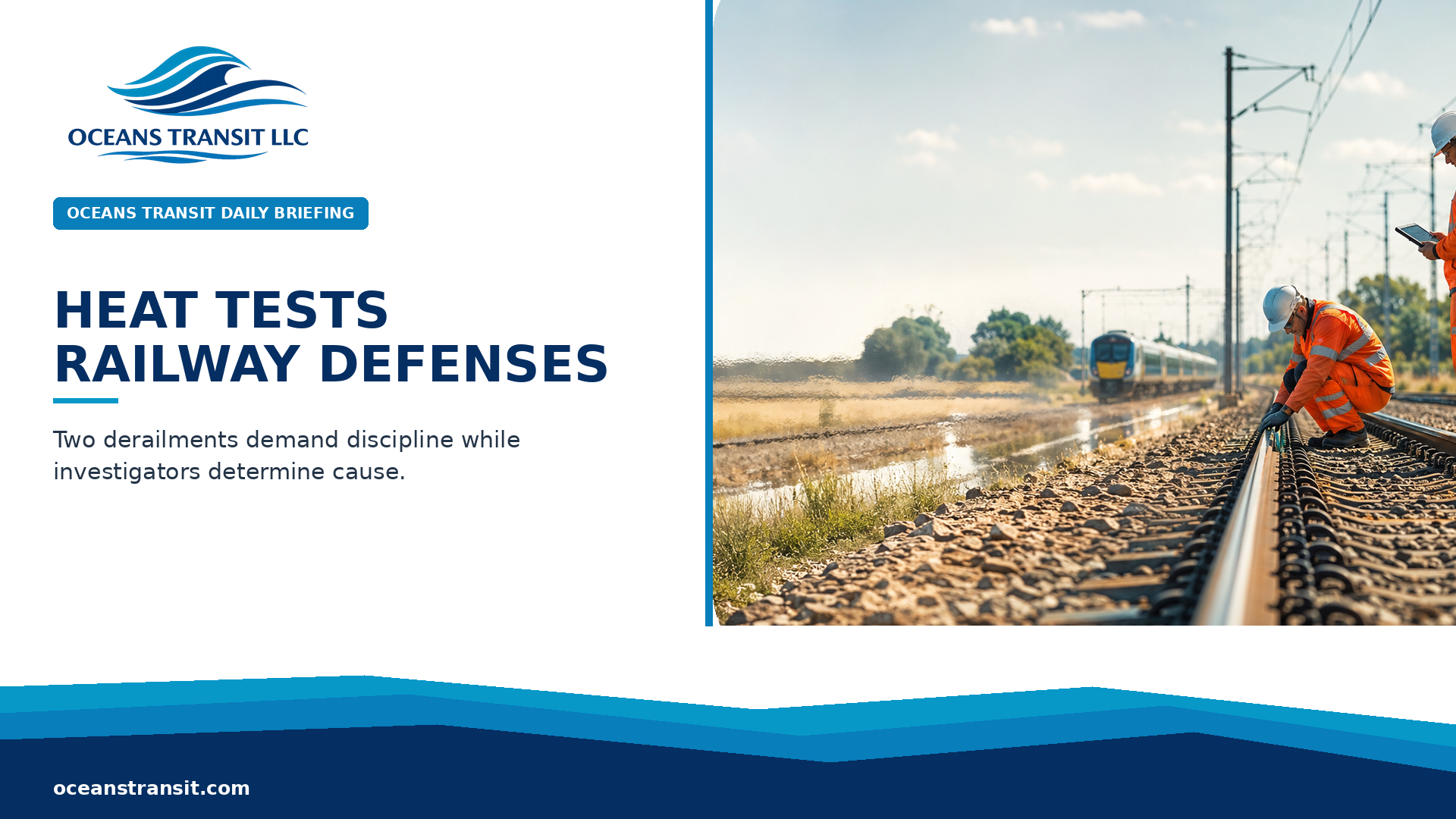
Two passenger trains derailed in Britain within less than 24 hours during a period of extreme summer heat. The timing makes the incidents an important rail-safety development, but it does not establish a common cause.
On August 13, a Southern passenger train traveling from London Victoria toward Eastbourne derailed near Lewes in East Sussex. British Transport Police said three carriages left the track and came to rest on their sides. Eleven people were injured, two seriously. Approximately 150 people were aboard, and passengers who were initially trapped were later evacuated.
The following day, a Greater Anglia train traveling from Southend toward London Liverpool Street derailed near Wickford in Essex. The affected cars remained upright. Authorities reported no injuries, and the Rail Accident Investigation Branch deployed inspectors to gather evidence.
Network Rail described the prolonged hot and dry weather as presenting exceptional challenges. It said the railway had been monitoring track temperatures, applying speed restrictions where appropriate and planning work around high-temperature conditions. Its safety leadership also cautioned against speculation and said internal investigations would consider all possible causes and factors.
That distinction must remain clear. Heat-related rail expansion, track buckling and soil movement are known hazards, but no official investigation has yet concluded that any of those conditions caused either derailment.
Why the pair matters
A single derailment demands investigation. Two passenger-train derailments in a short period justify a broader readiness review even before causes are known. Such a review should not presume failure. It should confirm whether defenses were operating as designed and whether worsening conditions required additional measures.
Infrastructure teams should be able to show which track sections were inspected, how rail and ground conditions were monitored, what thresholds triggered speed restrictions and how emerging defects were communicated. Control centers need clear authority and escalation paths when field information is incomplete. Operators and onboard personnel need usable instructions for protecting passengers and supporting an evacuation.
The Lewes response also presents a learning opportunity. Reporting indicates that all passengers were evacuated and that onboard railway employees acted quickly to support them. Those actions should be documented and incorporated into later lessons, while avoiding premature claims about what prevented more serious harm.
The multimodal consequence
Rail disruptions quickly become bus and accessibility problems. Planned and emergency replacement services require available vehicles, qualified operators, accessible equipment, safe pickup locations, dispatch coordination and accurate passenger information. Extreme heat may place those resources under pressure at the same time rail capacity is lost.
American transit agencies should therefore resist treating this as a distant railway story. State safety oversight agencies, rail operators, bus operations, emergency management and local responders can use it to test their own procedures for heat restrictions, infrastructure anomalies, evacuation and replacement transportation.
What agencies should consider next
Agencies should confirm that heat-response procedures specify measurable thresholds, accountable decision-makers and documentation requirements. They should review how track inspectors, dispatchers, operators and executives share abnormal-condition information. Tabletop exercises should include a derailment or infrastructure closure during heat conditions, with simultaneous demand for accessible bus replacement.
The next meaningful editorial milestone will be an official RAIB investigation notice, preliminary finding, urgent safety advice or final report. Until evidence is released, the responsible conclusion is limited: two serious events occurred during difficult environmental conditions, and the industry should verify its defenses without declaring a cause.
Correction/update note: This developing article should be updated when RAIB publishes formal findings or urgent safety information.
Sources and context
- Reuters, “UK Passenger Train Derailment in Southeast England Injures 11,” August 13, 2026
- The Guardian, “Network Rail Says Heat Poses ‘Exceptional Challenges’ After Two Trains Derail in 24 Hours,” August 14, updated August 17, 2026
- Rail Accident Investigation Branch, 2026 reports and safety publications