
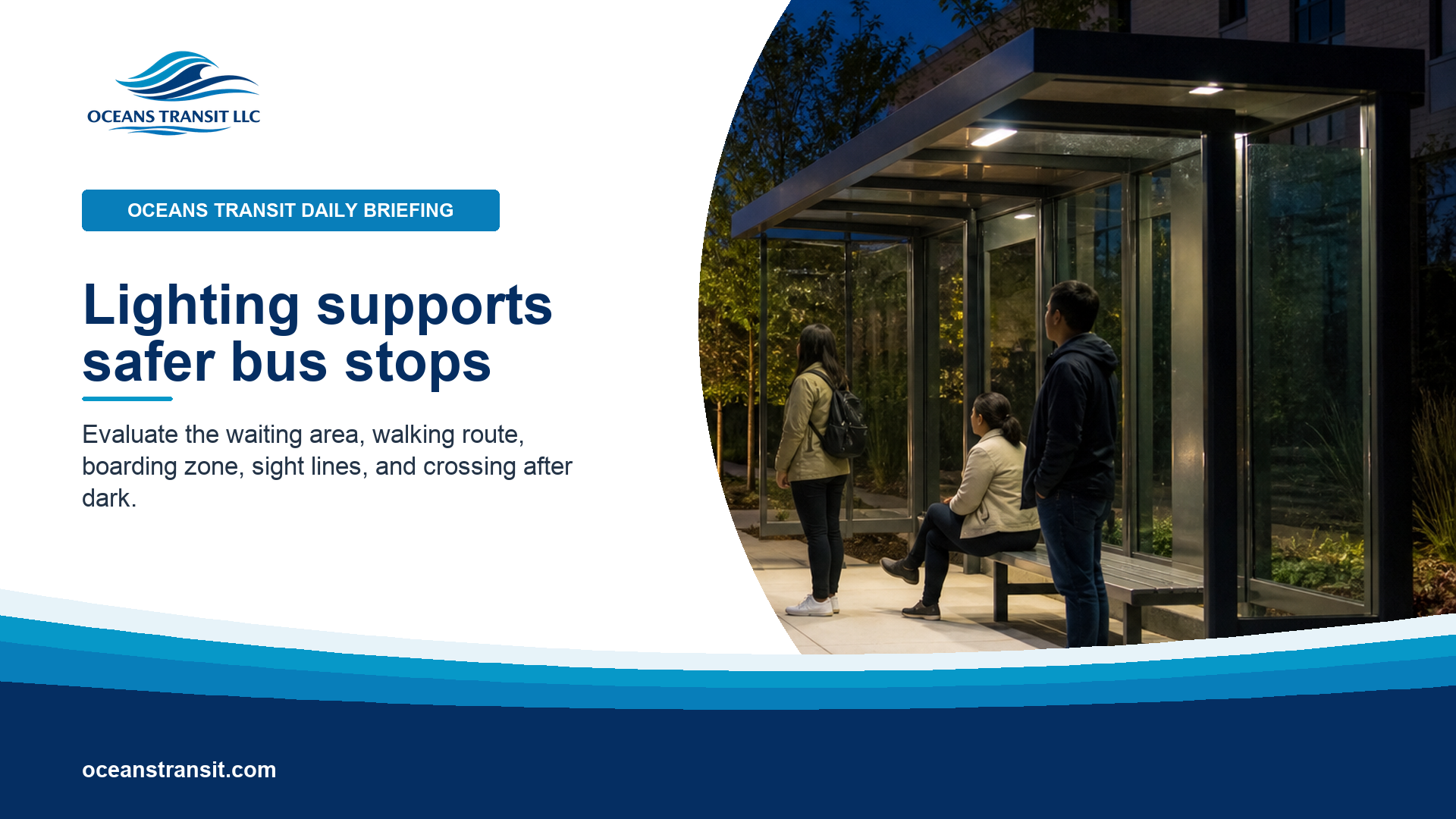
Bus stop lighting is a practical safety control that can improve visibility for riders, operators, motorists, bicyclists, and people using mobility devices after dark. Its value depends on more than whether a lamp is present. The more useful question is whether the entire path to and through the stop can be seen clearly and consistently.
The Federal Highway Administration’s 2022 guide, Improving Safety for Pedestrians and Bicyclists Accessing Transit, calls lighting a critical part of transit stop design. The guide explains that pedestrian-scale lighting helps people see one another, reminds drivers to expect pedestrian activity, and supports passenger comfort and personal security.
Lighting should cover the full transit-access area
A bright shelter surrounded by dark sidewalks does not provide a complete solution. Federal Transit Administration guidance advises placing transit-stop lighting near waiting areas and along walkways and ticketing locations. It also notes that ordinary streetlights may not provide adequate illumination in every situation.
An after-dark review should consider:
- The sidewalk or pedestrian route leading to and from the stop.
- The stop sign, route information, and waiting area.
- The accessible boarding and alighting surface.
- The curb edge and any change in elevation.
- The operator’s view of people waiting for service.
- Nearby driveways, bicycle movements, and pedestrian crossings.
- The shelter interior and exterior without reflections that obscure sight lines.
The goal is useful visibility, not simply maximum brightness. Poorly aimed fixtures can produce glare, deep shadows, reflections on shelter glass, or light spill into neighboring properties.
Priorities should reflect risk and nighttime use
Not every stop presents the same conditions. FHWA guidance advises agencies to consider nighttime crash history, traffic volume, nonmotorized users, crosswalks, raised medians, transit stops, and boarding activity when evaluating lighting needs.
Higher attention may be appropriate at stops with early-morning or overnight service, higher boarding activity during darkness, difficult pedestrian crossings, recurring outages, or nearby hospitals, senior housing, schools, and employment centers.
Ownership does not eliminate the need for coordination
Many transit agencies do not own the roadway, sidewalk, utility service, shelter, or land surrounding a stop. A workable procedure begins by documenting who controls each element and establishing a reliable way to route deficiencies.
FTA’s Public Transportation Agency Safety Plans framework requires applicable agencies to use Safety Management System processes, including hazard identification, safety risk assessment, and safety risk mitigation. It does not create a universal bus stop lighting specification, but an agency can use its safety-risk process to evaluate reported nighttime visibility concerns.
Maintenance determines whether lighting continues to work
Lighting is not a one-time installation. A fixture can remain physically present while providing little safety value because of lamp failure, battery degradation, dirty lenses, vandalism, vegetation, changed utility service, or a new obstruction.
A practical inspection process should include after-dark observations because many deficiencies are not apparent during daytime reviews. Repeat complaints or failures should be trended rather than treated as unrelated work orders.
A useful first step
A focused pilot can begin with a representative group of stops, including high-ridership locations, transfer points, stops near major pedestrian generators, and locations with customer or operator reports.
Review those stops after dark with operations, safety, accessibility, facilities, and the relevant roadway or property partner. Document what riders and operators can actually see, assign responsibility for deficiencies, and track corrective actions.