
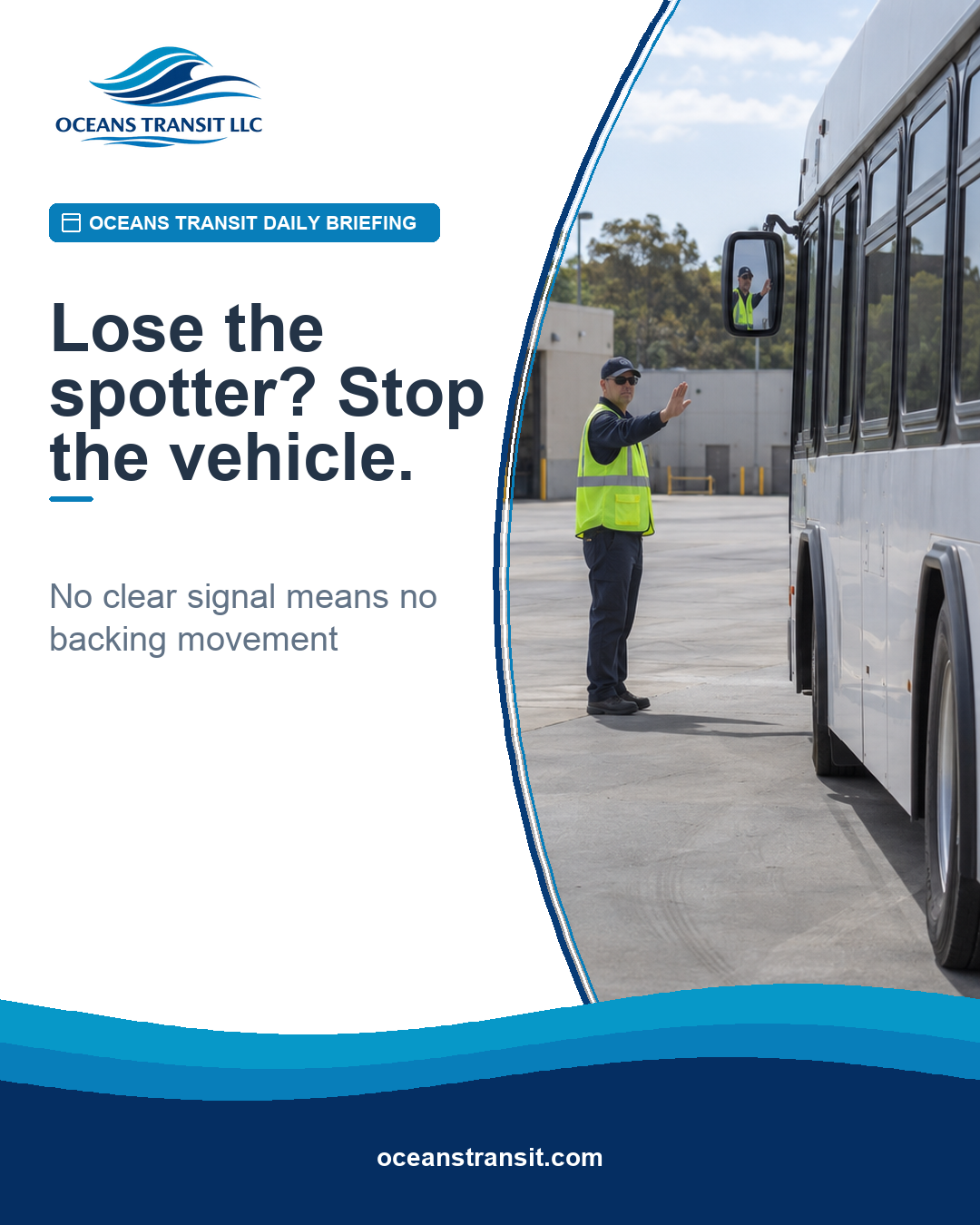
A spotter can reduce the risk of moving a large transit vehicle through a yard, maintenance bay or other close-quarters area. A spotter can also become the person most exposed to the vehicle. The control works only when the driver and spotter share the same signals, maintain a safe position and know exactly when to stop.
The Federal Transit Administration's bus accident investigation research identifies a second employee assisting a driver who is backing a bus as an example of risk mitigation. In an FTA bus-to-person collision webinar, Pierce Transit shared a spotter procedure built around agreed signals, continuous visual contact and safe positioning.
The Oceans Transit backing standard
Agency procedures always control. Where those procedures authorize backing with a spotter, Oceans Transit recommends this observable standard:
- Avoid the backing move when a forward route is reasonably available. Route design and yard layout are stronger controls than relying on perfect communication.
- Brief before movement. Agree on the path, stopping point, one set of hand or radio signals and which side the driver will use to see the spotter.
- Use one lead spotter. Other employees may watch hazards, but only the designated spotter directs the driver unless anyone gives an emergency stop signal.
- Keep the spotter out of the path and pinch points. The spotter must never stand between the moving vehicle and a fixed object.
- Stop on lost contact, uncertainty or disagreement. If the driver cannot see the spotter, does not understand a signal or receives conflicting directions, the vehicle stops and remains stopped until communication is restored.
The U.S. Occupational Safety and Health Administration's backover-prevention resources also describe spotters, cameras, proximity detection and traffic-control plans as possible controls. OSHA construction rules do not automatically become a transit operating rule, but their hazard logic is useful: obstructed rear views, blind spots and people on foot require layered protection.
Technology supports the move; it does not authorize it
Cameras, alarms, mirrors and proximity sensors add information. They do not give a driver permission to continue after the agreed human signal has disappeared. A dirty lens, blocked alarm, distorted mirror view or attention focused on one display can create a new gap.
Supervisors should observe the complete move, not just whether the bus reaches its parking position. A passing performance includes the pre-move brief, spotter position, agreed signals, slow controlled movement and an immediate stop when contact is deliberately interrupted during a safe training exercise.
Train the stop, not just the signal
Most backing instruction spends time on what “left,” “right” and “continue” look like. The most important response is simpler: no clear signal means no movement.
In a protected training area, have the spotter step out of the driver's view while the vehicle is moving at the agency-authorized training speed. The driver should stop without waiting for another cue. Reset the exercise only after the driver and spotter reestablish visual contact and confirm the plan.
That is an observable standard. It protects the spotter, prevents improvisation and gives a supervisor something stronger than “be careful” to coach and verify.