
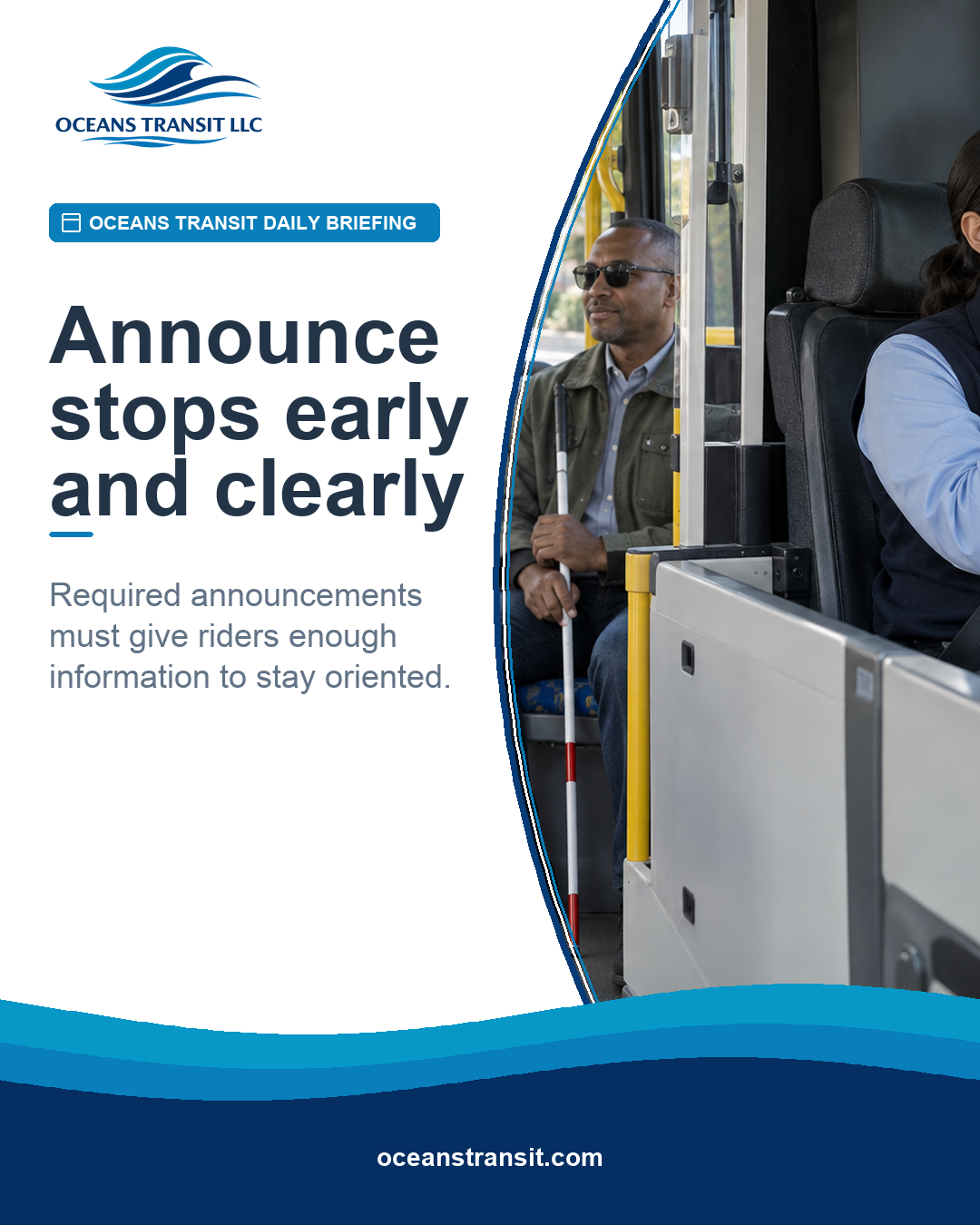
A fixed-route stop announcement succeeds when a rider can use it to understand where the vehicle is and prepare for the correct stop. Simply producing a sound—or assuming the automated system is working—does not meet the practical purpose of the requirement.
The Department of Transportation's Americans with Disabilities Act regulation at 49 CFR 37.167(b) requires fixed-route entities to announce stops at transfer points with other fixed routes, major intersections and destination points, and at intervals sufficient to orient riders with visual impairments or other disabilities. Transit personnel must also announce any stop requested by an individual with a disability.
Section 37.167(c) addresses route identification where vehicles for more than one route serve the same stop. The entity must provide a way for a rider with a visual impairment or other disability to identify the correct vehicle or be identified to the operator as seeking a particular route.
These are federal requirements. The operational practices below are Oceans Transit recommendations for delivering and assessing them consistently; agencies should follow their own approved procedures and any applicable local requirements.
Announce in time to act
An announcement that comes after the bus has passed the stop does not provide useful orientation. The operator or automated system should deliver the message early enough for a rider to recognize the location, signal for the stop when necessary and prepare to alight safely without rushing.
The message should use the agency's standard stop name and, when useful, the connecting route, major intersection or destination. Extra commentary can make the key information harder to distinguish. Clear, consistent wording is easier for riders to recognize and for supervisors to assess.
Automation does not remove responsibility
FTA's stop-announcement technical answer says announcements may be made by personnel or a recording system. The obligation remains with the transit entity. When an automated annunciator is silent, late, inaccurate or inaudible, the agency needs a defined operator fallback.
Oceans Transit recommends that the pre-trip or pullout process include the agency's prescribed check of the announcement equipment when that task belongs to the operator. During service, an operator who detects a failure should report it through the approved defect or communications process and make manual announcements as agency procedures direct.
The fallback needs to be practiced, not mentioned once in orientation. Operators should be able to use the microphone without taking attention from the roadway, pronounce local stop names and deliver the message at the correct decision point.
Assess the rider's experience
A classroom question—“Do you understand stop announcements?”—does not show whether a learner can perform the task. A stronger assessment uses a route segment or simulation and observes whether the operator:
- identifies the required transfer points, intersections and destinations;
- responds to a rider's requested stop;
- makes the announcement early enough to be useful;
- uses wording that is audible and understandable;
- recognizes an automated-system failure; and
- follows the agency's manual-announcement and defect-reporting procedures.
Supervisory checks should examine the same behaviors during service. A recording that plays is not the only measure; volume, timing, accuracy and route context determine whether it provides orientation.
Include external route identification
At a stop served by several routes, a rider may need to identify the correct vehicle before boarding. Agencies may use audible external announcements, operator communication or another effective method consistent with 49 CFR 37.167(c). Training should address the actual equipment and procedure used locally.
The operator should never assume that a person standing near the stop can read the destination sign or independently distinguish the arriving vehicle. A clear route-identification process supports access without singling out the rider for unnecessary attention.
Treat failures as a system signal
Repeated missed announcements may point to equipment reliability, route data, scheduling pressure, training, supervision or an unclear fallback—not merely an individual lapse. Agencies should capture patterns and apply their safety, maintenance, accessibility and customer-service processes to the underlying cause.
The legal requirement establishes what the service must accomplish. The daily operating standard should make that accomplishment observable: the right information, at the right time, in a form the rider can use.