
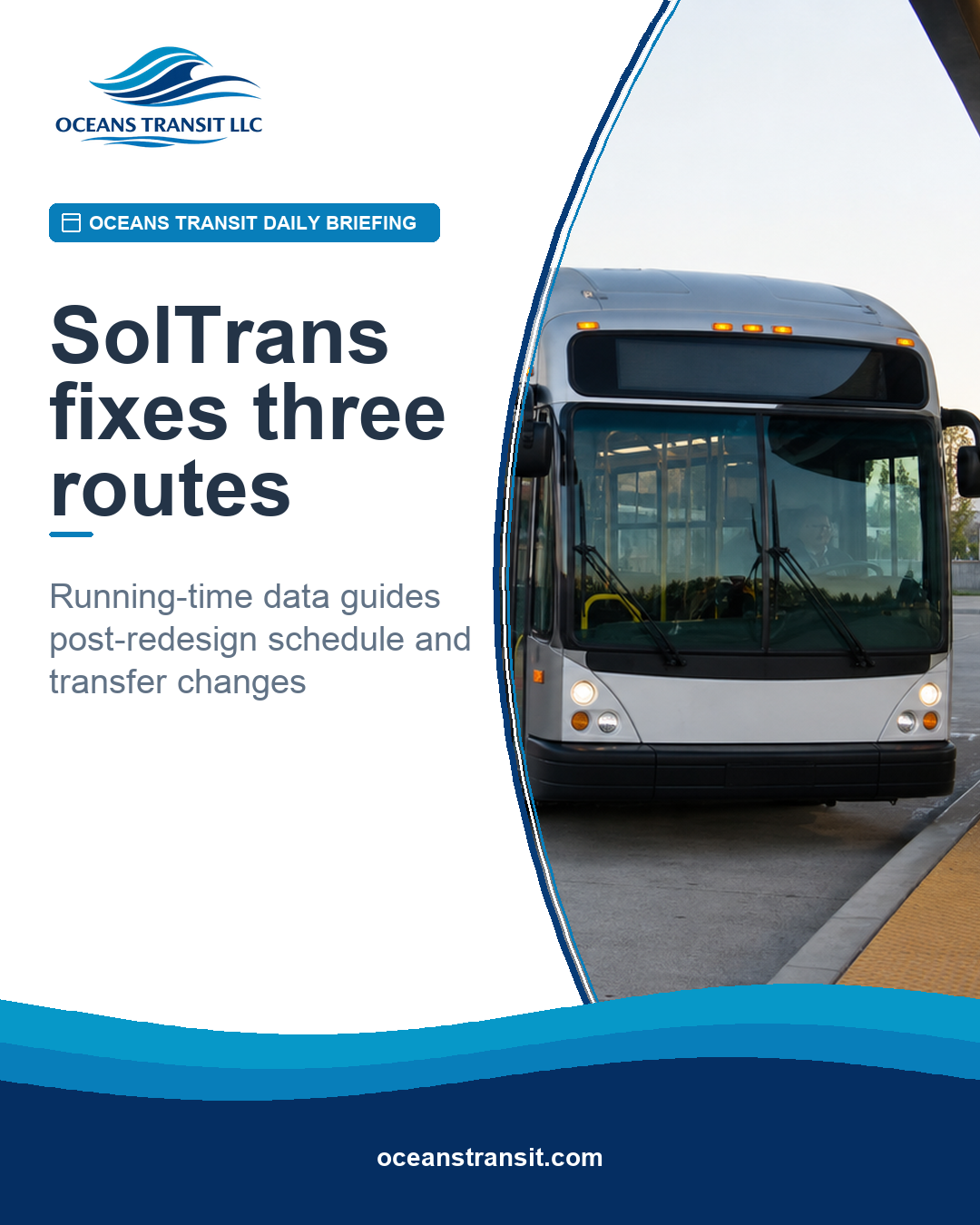
SolTrans corrects three routes after redesign launch
Observed running times and rider feedback are driving September 1 adjustments to Routes 40, 70 and 90—an early example of disciplined network stabilization after a major change.
SolTrans is making targeted schedule and routing corrections one month after launching a systemwide redesign. The September 1 changes affect Routes 40, 70 and 90 and follow the agency's review of actual running times and customer feedback since the new network took effect August 2.
The response is more instructive than a routine timetable update. SolTrans is showing what a post-launch stabilization period should do: identify where planned schedules do not match field conditions, correct transfer patterns and explain the changes while riders are still learning a new network.
According to the agency's August 28 service notice, Routes 40 and 70 will receive additional running time for trips to Concord BART. Their North Concord/Martinez BART service pattern will become directional: morning southbound trips will serve the station, while afternoon northbound trips will serve it. SolTrans also says the revisions address early-evening gaps.
Route 90 will serve Fairfield Transportation Center before Suisun Amtrak, reversing the previous sequence. The agency says that change is intended to provide a more direct trip and improve schedule reliability.
A smaller physical change carries its own customer-information risk. The Concord BART stop for SolTrans service moves to Bay B5 beginning August 31. Temporary maps and A-frame signs are planned until permanent signs are installed. Riders navigating a redesigned route and a relocated bay need consistent information across the timetable, trip planner, station sign and frontline explanation.
Corrections are part of responsible implementation
SolTrans' original redesign simplified the network and reallocated existing resources rather than adding new revenue. Changes of that scale rest on modeled running times, assumed demand and planned transfer relationships. The operating environment immediately tests those assumptions.
An agency should not treat every early correction as evidence that a redesign failed. Refusing to correct a mismatch can be the greater failure. The management question is whether the agency has a structured way to collect evidence, distinguish isolated complaints from repeatable operating patterns and make changes quickly enough to protect reliability.
The SolTrans notice identifies two evidence streams—actual running times and rider feedback. A complete stabilization review should also bring in operator reports, missed-transfer data, passenger loads, wheelchair boarding time, on-time performance by time period, layover and recovery use, and customer-assistance contacts.
A practical post-launch playbook
The September adjustments suggest several practices for agencies planning their own network changes:
- Define a stabilization window before launch. Identify who reviews the first days and weeks, which measures trigger action and who can authorize a timetable or routing correction.
- Separate running time from recovery time. Adding minutes may improve schedule accuracy, but the placement of those minutes determines whether operators have dependable recovery and riders keep useful connections.
- Audit transfer directions by time of day. A stop that benefits one travel market can add delay for another. Directional service can be a sensible compromise when the pattern is easy to understand.
- Treat temporary wayfinding as an operational asset. A bay move is not complete until maps, signs, digital channels and employees give the same answer.
- Close the feedback loop. Tell riders what changed and why. That demonstrates that participation continues after the public hearing and launch event.
Validation also needs a deadline. Operations teams should compare the revised schedules with a consistent baseline after enough trips have run to reveal weekday and time-of-day patterns. If added running time improves terminal arrival but creates excess layover elsewhere, or if a directional stop pattern protects one transfer while weakening another, the agency should document that tradeoff and decide whether a second adjustment is warranted. Publishing a concise follow-up would help riders understand whether the September changes solved the problems they were designed to address.
SolTrans has not yet published a performance evaluation of the full redesign, and these corrections should not be mistaken for one. They are, however, a visible sign of active management. The next test is whether the revised running times hold, transfer reliability improves and customer questions decline after September 1.
For transit leaders, that is the larger lesson: launch day is a milestone, not the finish line. A redesigned network becomes reliable through observation, correction and clear communication after service reaches the street.