
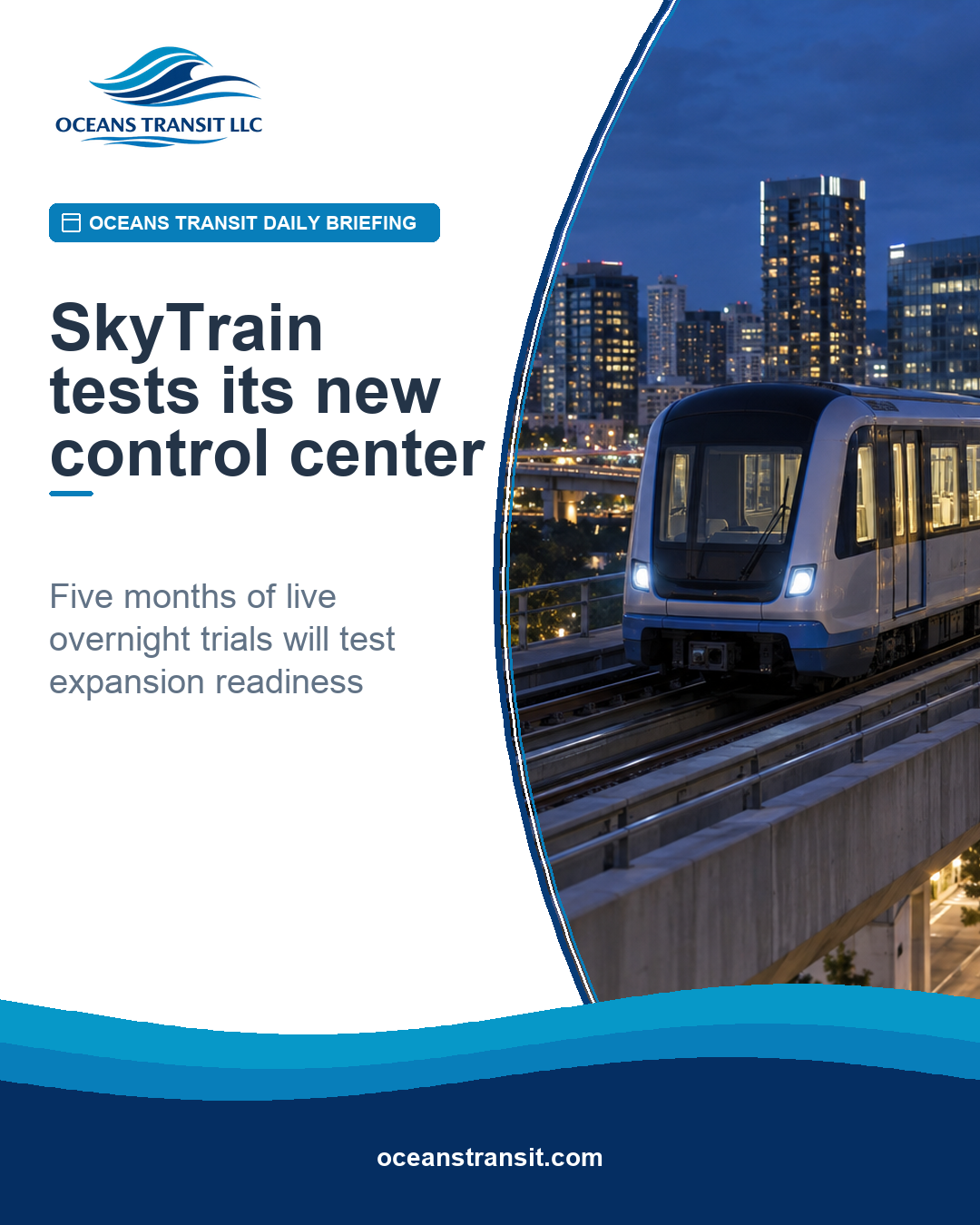
Metro Vancouver's SkyTrain entered a consequential testing phase early October 3. TransLink is running trains without passengers on portions of the Expo and Millennium lines during overnight windows while a new Operations Control Centre gradually assumes live control functions.
The testing is scheduled to continue for about five months. TransLink says it will occur outside regular service hours, without service reductions, on early Saturday, Sunday and selected Monday mornings. Locations will rotate, and the agency says alarms and announcements will be limited where possible to reduce overnight noise.
The immediate objective is not a public launch. It is operational proof.
Why the control center matters
TransLink says the 40,000-square-foot facility is expected to become fully operational in 2027. It will support the Broadway Subway Extension and the Dave Barrett Surrey Langley SkyTrain Extension while adding control capacity to a system that has grown to roughly four times its original size since 1985.
During the overnight program, the new center is expected to exercise three distinct conditions: regular daily service, routine maintenance and emergency response. That scope matters. A control center cannot be accepted solely because its screens display train locations or its communications work in a quiet room. Dispatchers, maintainers and field staff need evidence that the system performs when service patterns change, equipment is taken out of service and abnormal conditions develop.
The transferable lesson: test operations, not just technology
For agencies preparing a new control room, dispatch platform or signal interface, Oceans Transit recommends a structured acceptance sequence:
- Define the operating scenario. State what is being tested, which systems are live, who has authority and what ends the test.
- Set observable success criteria. Measure command transfer, alarm recognition, communications, decision time and restoration—not simply whether the software stayed online.
- Exercise degraded conditions. Include a failed communication path, unavailable asset, conflicting information or emergency response decision.
- Capture operator workload. A technically correct system can still create delay or error if information is difficult to interpret.
- Record and close findings. Assign every defect or procedural gap an owner, interim control and retest requirement.
These are Oceans Transit recommendations, not a description of TransLink's unpublished test plan.
What to watch next
TransLink has described the purpose and schedule, but has not publicly released detailed acceptance criteria or early test results. The most useful follow-up will be evidence of what the overnight program discovered: software or communications corrections, procedure changes, staff qualification needs, emergency-response lessons and readiness gates for the 2027 transition.
The larger lesson is straightforward. Expansion readiness is not achieved when a new room opens. It is achieved when people, procedures and technology perform together under realistic conditions—and when the agency can show how it knows.