
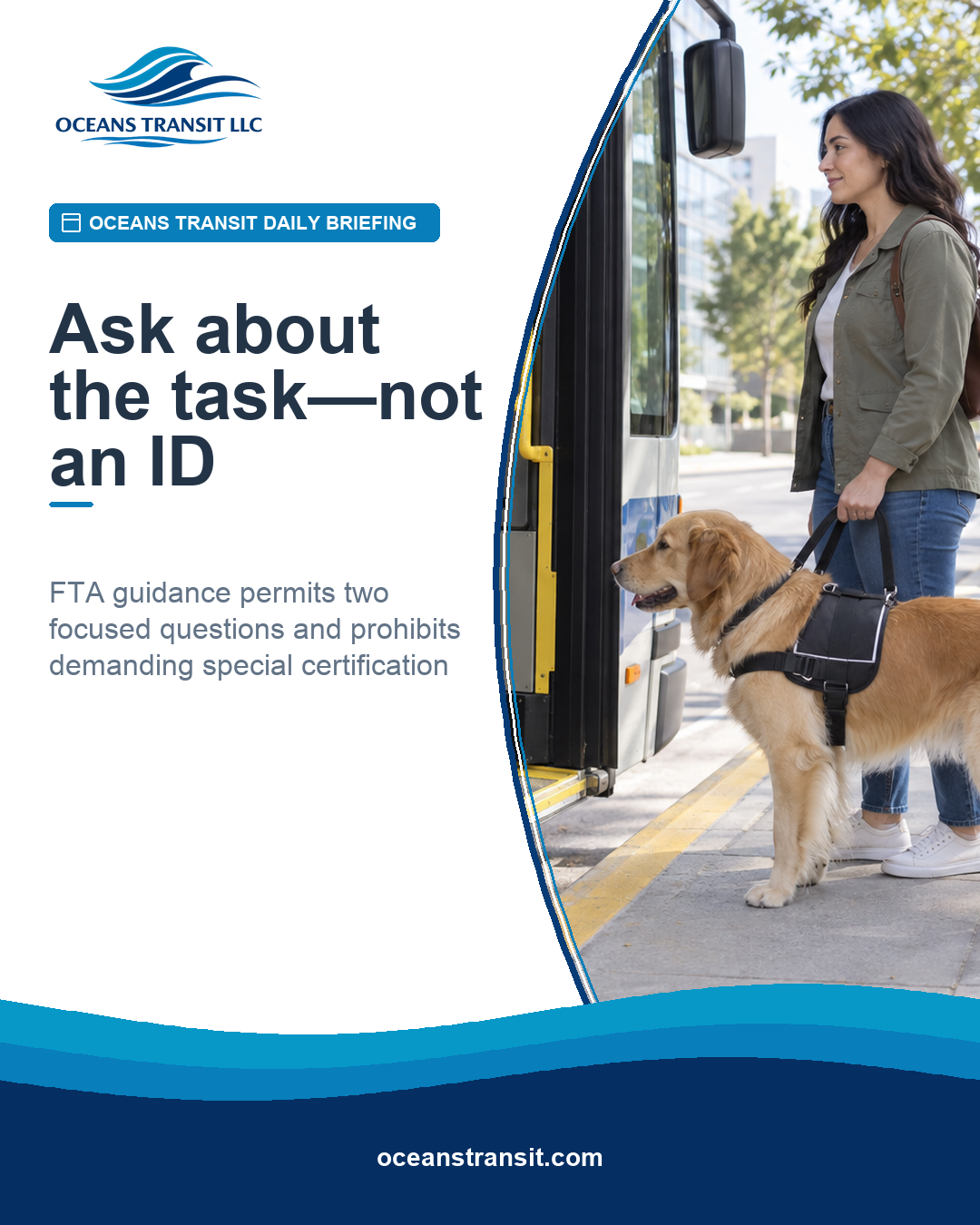
A rider arrives with an animal, and the animal's work is not obvious. The next sentence from a transit employee can either resolve the interaction professionally or turn it into an avoidable access problem.
The controlling transportation rule is direct: 49 CFR 37.167(d) says a transit entity must permit service animals to accompany individuals with disabilities in vehicles and facilities. FTA's current frequently asked questions explain that personnel may ask whether the animal is a service animal and what task it has been trained to perform. They may not require a special identification card or ask about the person's disability.
Use the transportation definition
Transit personnel need the Department of Transportation definition, not a rule remembered from another public setting. FTA's ADA Circular 4710.1 explains that DOT defines a service animal as an animal individually trained to work or perform tasks for an individual with a disability. Most service animals are dogs, but the DOT transportation definition recognizes that another animal may meet the standard.
That differs from the narrower Department of Justice definition used in many nontransportation settings. FTA specifically cautions transit providers not to replace the DOT transportation standard with the DOJ definition.
The key distinction is trained work or tasks. An animal whose only function is emotional support or comfort does not meet DOT's training-based definition. A transit agency may choose to accommodate pets or comfort animals under its own rules, but that is a local decision rather than the federal service-animal requirement.
Two questions keep the interaction focused
FTA's circular says that when clarification is needed, personnel may ask:
- Is the animal a service animal required because of a disability?
- What work or task has the animal been trained to perform?
The employee should not ask the rider to disclose a diagnosis, explain the disability or produce certification. A vest, tag or card is not the federal test, and the absence of one does not establish that the animal is not a service animal.
Some disabilities are not apparent. FTA lists examples such as animals trained to alert a person to an oncoming seizure, respond during a seizure or remind a person to take medication. Personnel should listen for the trained task rather than judge whether the rider “looks disabled.”
Exclusion requires a real condition—not discomfort
FTA says a service animal may be excluded if it poses a direct threat, creates a seriously disruptive atmosphere or is not under the rider's control. The context matters. The circular notes that a dog that barks occasionally would not likely be considered out of control, while an animal that bites a driver or rider presents a different condition.
Allergies from another rider or employee are not, by themselves, grounds to deny transportation to the person using a service animal. FTA also says a passenger—not the operator—is responsible for caring for the animal. Transit personnel may deny a request that the driver take charge of it.
These are individualized service decisions. Agencies should route uncertain or disputed cases through their ADA and supervisory process rather than asking frontline employees to invent a legal standard at the farebox.
Train the words, not only the rule
Oceans Transit recommends that instructors assess this interaction as a short performance task. Give the learner three scenarios:
- an obvious guide-dog task where no inquiry is needed;
- a non-obvious task where the two permitted questions are appropriate; and
- actual behavior that may require a direct-threat or control assessment under agency procedures.
The learner passes when the questions are neutral, no ID or diagnosis is demanded, and the employee identifies the correct escalation path without arguing with the rider. That assessment method is Oceans Transit guidance; it is not an additional FTA requirement.
Supervisors can reinforce the standard with a pocket-sized prompt: Task, not tag. Behavior, not appearance. Escalate uncertainty, not conflict. The phrase is a memory aid, not a substitute for the rule or agency procedures.
Keep local materials aligned
Agencies should compare operator manuals, contractor instructions, security procedures, customer-service scripts and complaint-response materials with the DOT rule and FTA circular. Remove any direction that requires a certificate, limits service animals to dogs because of the DOJ rule or invites personnel to ask about a rider's diagnosis.
A correct service-animal interaction is brief. The goal is not to investigate a passenger. It is to apply the transportation rule consistently, protect access and address only the trained task and any observable safety or control condition.