
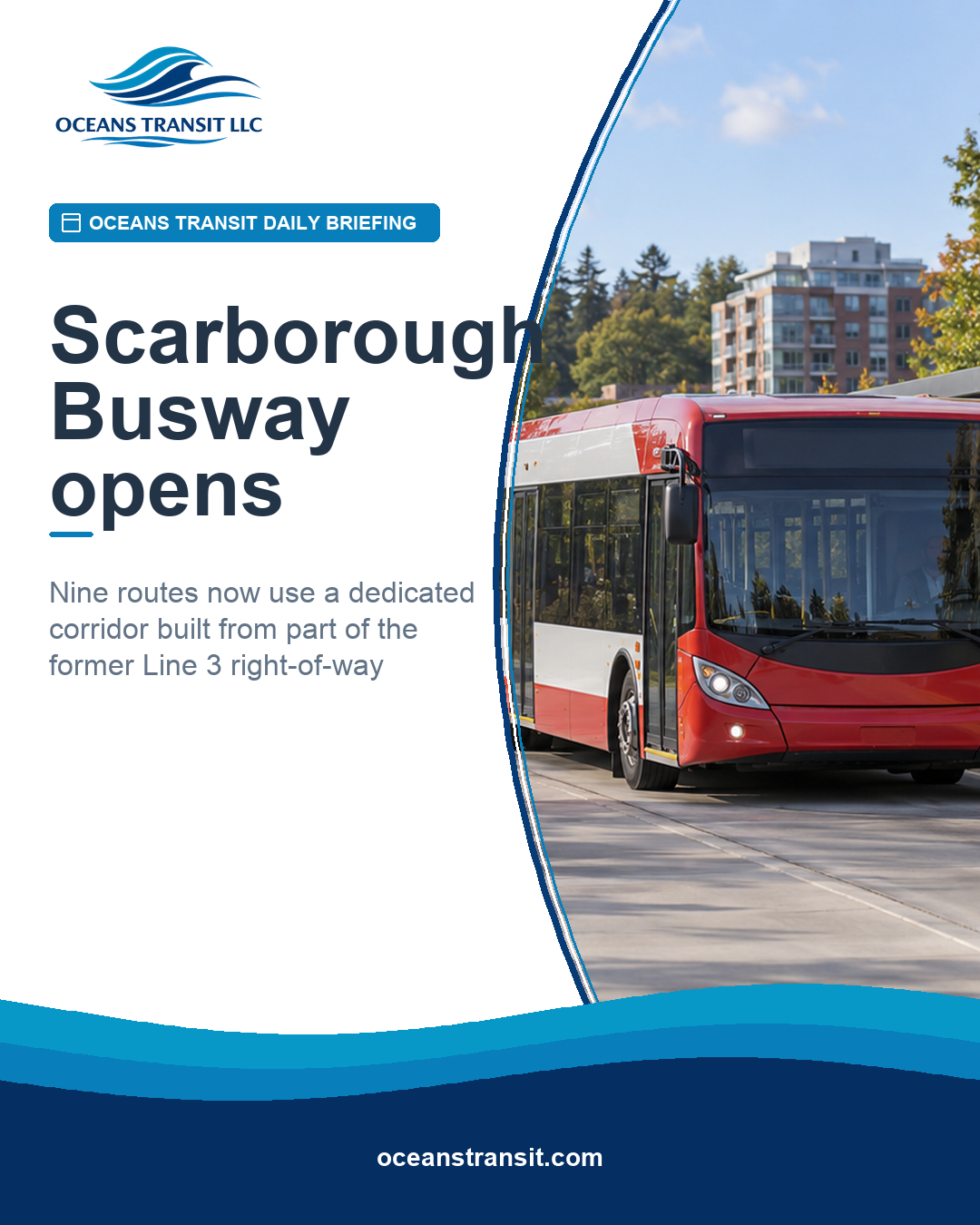
Scarborough Busway turns former rail corridor into a faster bus link
A four-kilometre dedicated corridor is now carrying nine Toronto bus routes, offering a practical example of how agencies can reuse retired rail infrastructure while a permanent rapid-transit project remains years away.
The Toronto Transit Commission opened the Scarborough Busway for regular service on September 30, shifting nine routes from mixed-traffic streets onto part of the former Line 3 Scarborough right-of-way. The dedicated corridor runs between Kennedy and Ellesmere stations before buses continue toward Scarborough Centre on priority infrastructure along Ellesmere Road.
The physical project is only four kilometres long, but its operating effect reaches well beyond the corridor. Routes 38, 129, 131, 133, 154, 903, 904, 938 and 939 now use the busway. Together, they form the principal bus replacement network created after Line 3 closed in 2023.
TTC says the change reduces the trip between Kennedy and Scarborough Centre stations by about seven minutes, to approximately 15 minutes. The agency also expects the corridor to serve more than 100,000 riders each week. Those are planning estimates; actual performance will depend on reliable operations, transfer conditions and how the route changes work in daily service.
Reusing an established transit path
The busway demonstrates a useful principle for agencies managing a long gap between the retirement of one mode and the arrival of another: preserve the transit function of the corridor whenever practical.
After Line 3 closed, replacement buses initially operated on Kennedy Road and Midland Avenue. The new busway moves them onto a separated path that avoids much of the delay and variability of general traffic. It also reuses stations at Lawrence East and Ellesmere and adds a stop at Tara Avenue and Mooregate Avenue.
For riders, the benefit is not simply a faster vehicle. A dedicated route can make scheduled running times more dependable, improve transfers at Kennedy and Scarborough Centre and give dispatchers a more stable operating environment. For the agency, it can reduce the amount of recovery time needed to absorb unpredictable street congestion.
The project also arrived more than six months earlier than the TTC's previously projected date. That acceleration matters because interim services are often treated as temporary even when riders will depend on them for years. The Scarborough Subway Extension is not expected to open until the 2030s, so the quality of the bridge service is an immediate operating issue, not a minor placeholder.
The opening is an operations change
Nine routes entering a new shared corridor require more than construction completion. Operators need clear approach and platform procedures. Supervisors need plans for incidents, disabled buses and congestion at stops. Maintenance teams need a dependable inspection and winter-response program. Customer information must make clear which routes moved and which street services remain.
That last point is important in Scarborough. The routes shifted to the busway no longer use their former paths on Kennedy Road and Midland Avenue. Riders traveling along those streets are directed to Routes 43 Kennedy and 57 Midland. A faster trunk connection can still create confusion or longer access trips if the transition is not explained consistently across maps, stops, apps and operator announcements.
The first months should therefore be treated as a structured learning period. Agencies considering similar conversions should track more than corridor travel time. Useful measures include:
- trip-time reliability by time of day;
- transfer success and missed connections;
- platform crowding and dwell time;
- incidents, disabled vehicles and response time;
- accessibility issues at stops and transfer points;
- operator reports about sight lines, turns and stop approaches; and
- rider feedback from neighborhoods affected by route changes.
A training opportunity, not just an infrastructure story
The project offers a strong scenario for operator and supervisor training. A dedicated busway changes the risk profile: cross traffic may be limited, but higher and more consistent speeds can increase the consequences of a mistake. Platform approaches, pedestrian expectations, merging points, lane discipline and emergency access should all be reflected in route qualification and refresher instruction.
Instructors can also use the opening to test whether classroom guidance transfers to the road. Ride checks, structured operator feedback and review of early incidents or near misses can show whether procedures are understood and workable. If recurring problems appear, the response should be a change to the system or training—not an assumption that workers will adapt on their own.
Winter operations will be another practical test. A separated corridor needs a defined snow-and-ice plan, including responsibility for roadway clearance, platforms, accessible paths and emergency access. The operating plan should be rehearsed before the first major storm, not improvised when service is already disrupted.
What transit leaders should watch
Scarborough's new busway should be judged as a service program, not solely as a completed capital project. Its value will be demonstrated through dependable travel times, safe operations, understandable connections and a better daily experience for riders who have already endured the loss of Line 3.
The larger lesson is transferable. When an agency retires a rail facility before its replacement is ready, the existing right-of-way may still be its most valuable operational asset. Reusing it well requires construction, but the long-term result depends on disciplined service planning, operator preparation, maintenance and honest measurement after opening day.
For Toronto, September 30 was the beginning of that test.