
San Clemente rail closure puts continuity planning to work
Wave and erosion damage closed a critical Southern California rail segment, turning inspection discipline, passenger transfers and cross-agency coordination into the immediate operating test.
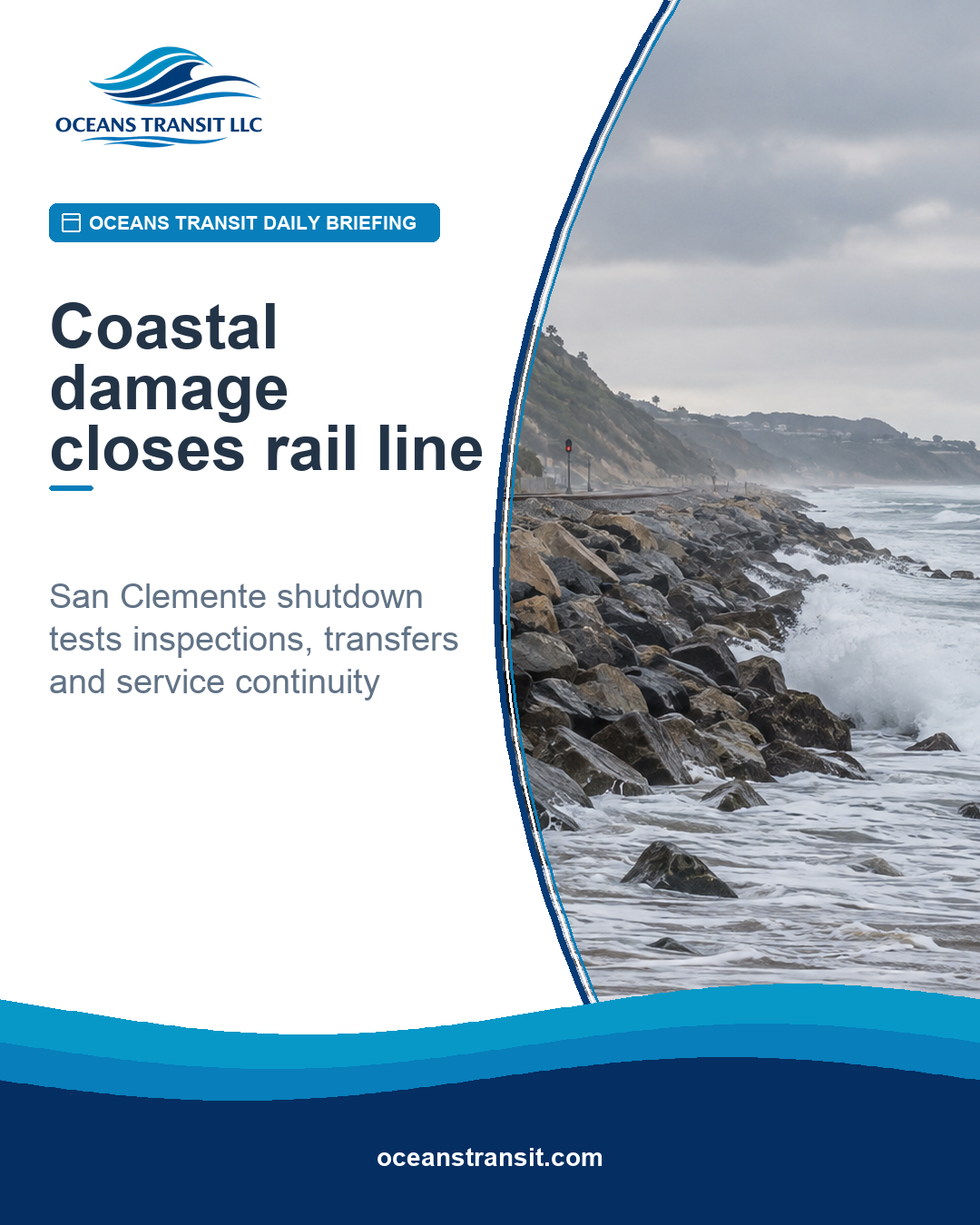
Passenger rail service through coastal San Clemente remained interrupted at the September 9 research cutoff after high tides and powerful waves damaged the railroad area. The Orange County Transportation Authority said additional erosion and slope damage was observed after waves overtopped the tracks and affected previously placed protective rock. The line was closed so crews could assess conditions and perform emergency stabilization.
The disruption reaches beyond one operator. The corridor carries Amtrak Pacific Surfliner intercity trains, Metrolink commuter service and freight traffic. Pacific Surfliner's live travel advisory directs affected passengers to bus connections between Irvine and Oceanside. Metrolink has also advised riders of impacts south of Laguna Niguel/Mission Viejo.
No confirmed reopening time was available at the cutoff. That uncertainty is operationally important. It prevents a precise end-to-end travel promise and requires agencies to manage a changing condition without allowing schedule pressure to become a substitute for inspection evidence.
A closure is a coordinated safety decision
Coastal rail interruptions can look simple on a service map: a line segment closes and a bus fills the gap. In practice, the decision connects engineering, dispatch, passenger information, bus operations, accessibility and partner agencies.
The first responsibility is a common description of the hazard. Track condition, signal reliability, slope behavior and wave exposure must be assessed by the qualified teams responsible for each system. A red or green operating decision should come from agreed criteria and documented observations, not from the absence of a new visible failure.
The second responsibility is to control movement around the closed area. Rail operators, contractors and any inspection personnel need one protected work plan. Passenger trains, freight movements and on-track activity cannot be managed as separate stories when they share the same corridor.
The third responsibility is customer continuity. A bus bridge changes capacity, travel time, baggage handling, boarding location and accessibility. Riders need to know where the transfer occurs, which train will accept them on the other side, whether bicycles or mobility devices can be accommodated, and how much extra time to allow. “Bus connection available” is only the start of usable information.
What transit teams should test now
The San Clemente closure offers a practical exercise for any agency with infrastructure exposed to water, slope movement or extreme weather:
- Closure triggers: Define who can stop service, what evidence is required and how uncertainty is treated.
- Shared operating picture: Give infrastructure, operations, communications and partner carriers the same current status, time stamp and next decision point.
- Transfer capacity: Compare rail loads with available buses, operators, accessible spaces and terminal capacity before promising a seamless bridge.
- Accessible instructions: Describe exact boarding points and assistance channels in formats that riders with visual, hearing, mobility or cognitive disabilities can use.
- Reopening discipline: Require documented inspection and functional checks for track, signals and any affected protective works before resuming service.
- After-action capture: Record when alerts changed, where passengers accumulated and which exceptions required improvisation.
Agencies should also separate simultaneous events clearly. Pacific Surfliner lists a planned September 12–13 corridor closure for construction, but that scheduled work is distinct from the current emergency interruption. Blending the two can lead riders to assume the emergency has a fixed construction timetable—or that a planned outage began early. Every alert should identify the event, effective period and controlling instruction.
The broader lesson is not that every coastal corridor needs the same engineering response. Conditions, ownership and remedies differ. The transferable lesson is that infrastructure resilience includes the decision system around the asset: observable thresholds, authority to stop, substitute transportation, accessible communication and evidence-based reopening.
San Clemente is now testing that system in real time. Until qualified teams confirm the corridor can safely carry traffic, the measure of performance is not how quickly trains return. It is whether the agencies protect the site, keep passengers oriented and make each next decision from verified conditions.