
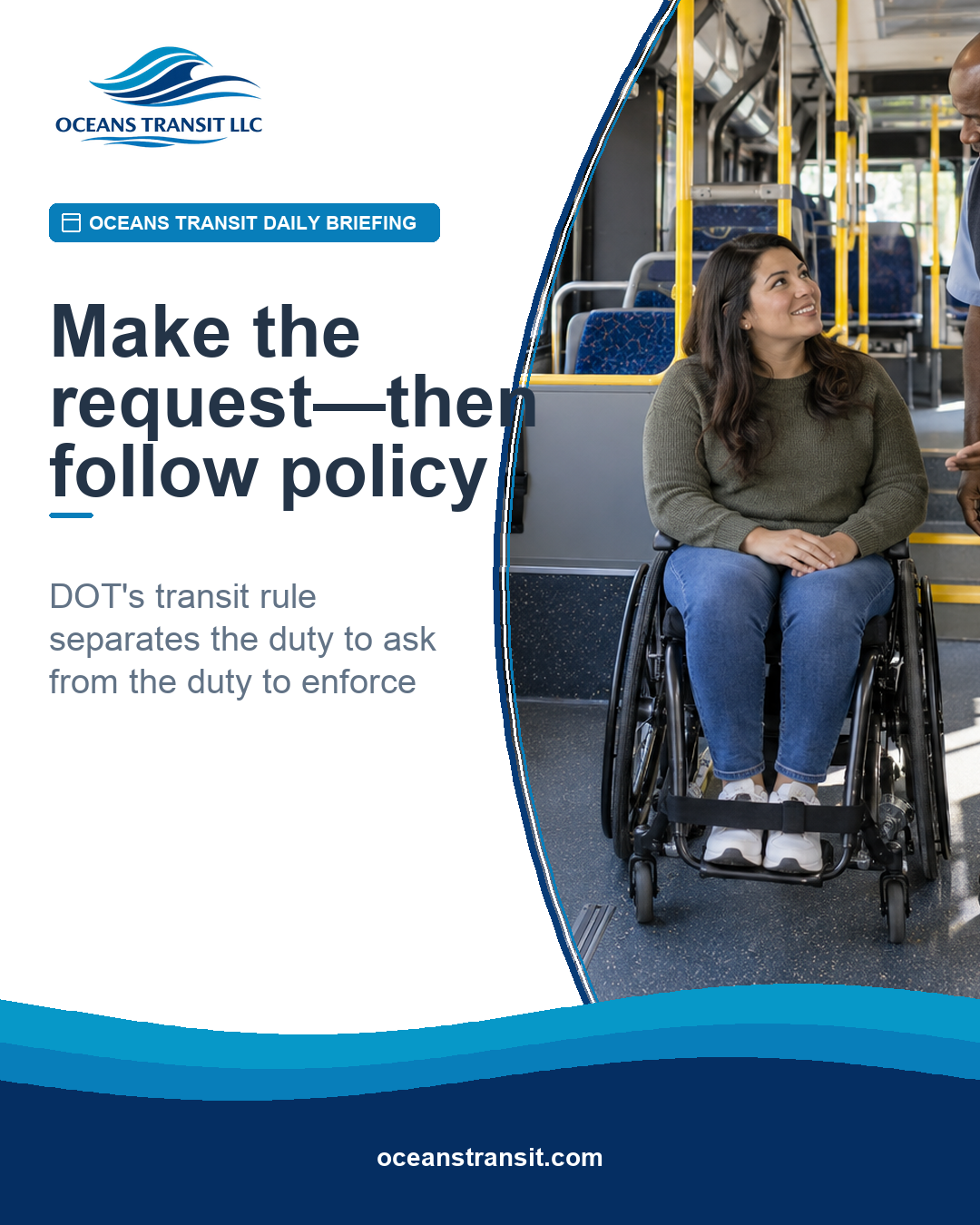
A rider using a wheelchair boards, but a fold-down seat blocks the securement area. Or a rider with a disability needs a priority seat that is occupied by someone who does not need it. What is the operator expected to do?
Under 49 CFR 37.167(j), the transit entity must ask the appropriate occupant to move so the rider with a disability can use the seat or securement location. FTA's current guidance is equally clear that the federal rule does not require the operator to compel the person to move after the request is made.
The standard is not “ignore it” and not “start a confrontation.” It is: recognize the need, make the request, and follow the agency's policy for what happens next.
The securement area has a specific distinction
For designated priority seats, the regulation excludes another rider with a disability or an elderly rider from the group personnel are required to ask to move. The securement area is different. When someone is sitting in a fold-down or movable seat over that location, the rule may require the request even if that person is elderly or has another disability, because the wheelchair user needs the securement space to ride.
Bus design can make that decision difficult when the same fold-down seats serve both purposes. FTA encourages agencies to develop local procedures that guide operators through those situations.
On rail, the requirement applies to the extent practicable because personnel may not be present in every car. When agency personnel are present and can act, FTA says they should make the request if needed and practicable.
Local policy controls the next step
The federal rule does not require enforcement of the request. An agency may, however, adopt a mandatory-move policy. FTA encourages agencies that do so to tell riders and post signs reflecting the policy near the priority seating and securement areas.
That means instructors cannot stop at a slogan. They need the actual local rule. Operators should know:
- the exact neutral words to use;
- who should be asked to move from a priority seat versus a securement area;
- whether the agency has a mandatory-move policy;
- when to contact dispatch or a supervisor;
- how to avoid disclosing or debating a rider's disability; and
- how to document a refusal or service impact under local procedures.
Practice the request out loud
Oceans Transit recommends a short scenario assessment. The learner receives a crowded-bus situation and must make the required request without ordering, shaming or inviting riders to argue about who is “disabled enough.”
A workable prompt might be: “This space is needed for a rider using a mobility device. Please move to another available area.” The precise words should match agency policy and conditions. The pass standard is observable: the employee identifies the correct space, makes a calm and audible request, follows the local escalation path and avoids physical enforcement unless separately authorized and trained under agency policy.
That scenario method and sample language are Oceans Transit recommendations, not additional federal requirements.
Signs support—but do not replace—the employee
Section 37.167(j) also addresses signage for priority seating and wheelchair securement areas. The sign should tell occupants that they should comply with requests from transit personnel to vacate the location for a rider with a disability.
But a sign cannot make the real-time request. Supervisors should observe whether operators notice the need and use the agency's procedure consistently. If riders regularly face the conflict alone, the system has posted a rule without operationalizing it.
Accessibility is created in the moment of service. The operator's calm request is a small action, but it can determine whether a rider can use the bus at all.