
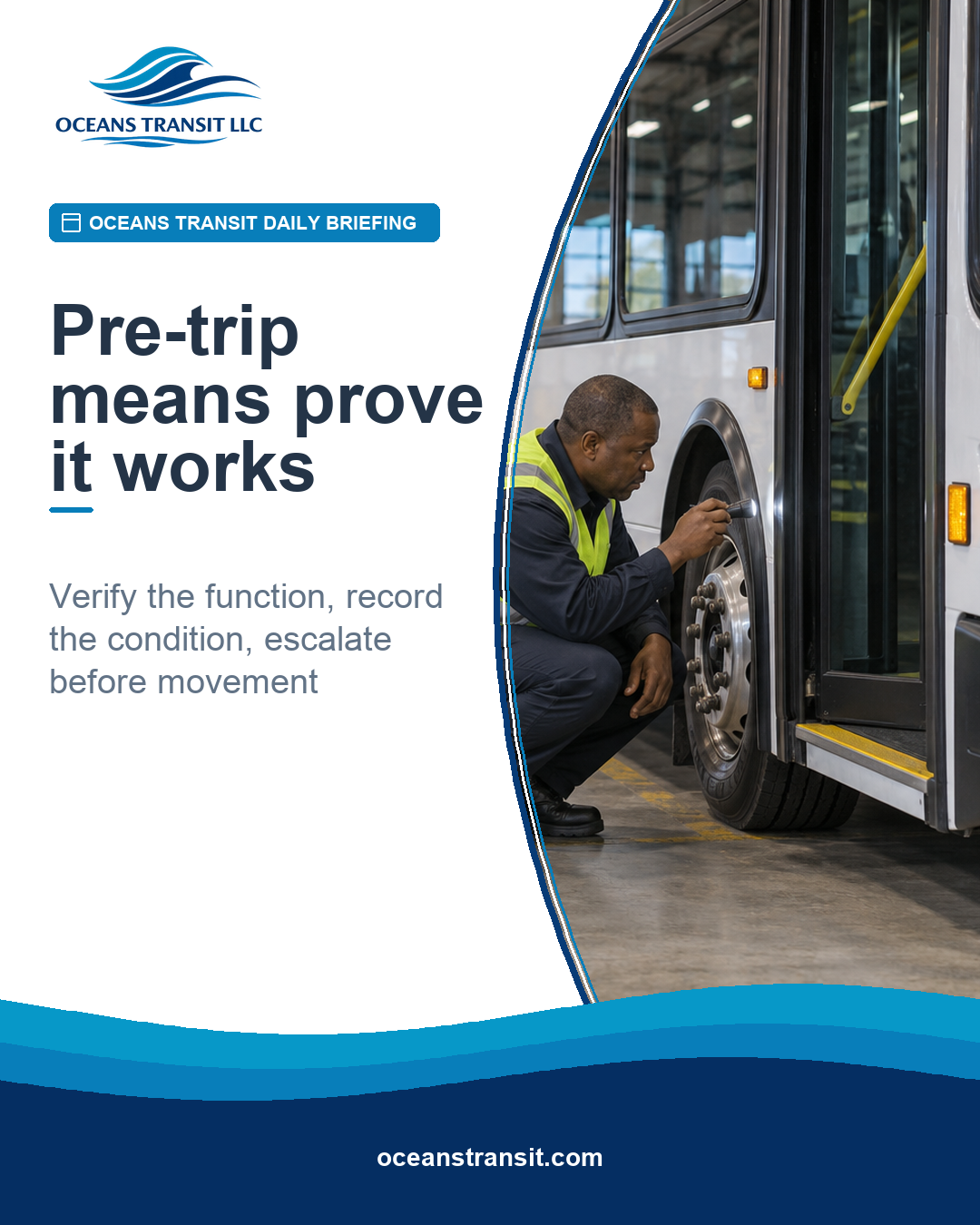
Pre-trip inspections are vulnerable to familiarity. The same vehicle, the same form and the same early-morning sequence can slowly turn an active safety check into a remembered routine.
The Federal Transit Administration's emergency-response guidance describes a pre-trip inspection as a way to help ensure a vehicle's safe mechanical condition before service. Its sample directs drivers to check exterior lighting, tires, mirrors, wipers, lift or ramp operation, brakes, steering, communications and other equipment. FTA's bus-accident investigation guidance also identifies pre- and post-trip records as critical evidence when investigators examine a possible mechanical failure.
That gives the inspection two jobs: detect a condition now and preserve a reliable record for later.
The Oceans Transit standard: verify, record, escalate
For every safety-critical item, use three deliberate actions.
- Verify the function. Do not confirm an item from memory or appearance alone when it can be safely operated. Activate the light, cycle the ramp, test the wiper, apply the brake or follow the vehicle-specific procedure.
- Record the condition. Identify what was observed, not merely that the item was checked. Use the vehicle number, location, symptom and time required by agency procedure.
- Escalate before movement. Apply the agency's defect-classification and out-of-service rules. When the operator is uncertain, pause and contact the designated supervisor or maintenance authority rather than making an informal risk decision.
These steps are Oceans Transit recommendations. The precise inspection sequence and serviceability decision belong to the agency's approved procedures, manufacturer information and applicable law.
Watch for practical drift
FTA's accident-investigation guide lists “practical drift” among conditions investigators may examine when actual work has moved away from written procedure. Drift rarely begins with a dramatic decision. It appears in small substitutions:
- looking at a ramp without cycling it;
- assuming a warning light is the same intermittent fault reported yesterday;
- checking a mirror's presence but not the driver's actual field of view;
- copying a vehicle number or time from a prior entry; or
- relying on another employee's inspection without a permitted handoff.
Supervisors should observe the task periodically, not just audit completed forms. The coaching question is: Show me how this check proves the item is ready.
Make defects easier to describe
“Not working” is a starting point, not a diagnosis. A useful report states what the operator commanded, what the equipment did, whether the result was repeatable and whether any warning appeared.
For example: “Front door reopened twice after reaching the closed position; amber door warning remained illuminated; repeated at 5:42 a.m.” That description gives maintenance a reproducible condition and gives the supervisor a better basis for the service decision.
A two-minute instructor exercise
Place one realistic defect or simulated abnormal indication in a stationary training vehicle. Ask the learner to inspect the related system, describe the evidence and state exactly where the decision transfers to maintenance or supervision. Score the observation and communication—not how quickly the learner finishes.
A pre-trip inspection should never reward speed at the expense of proof. The standard is not “I went down the list.” The standard is “I verified readiness, documented the exception and stopped when the decision exceeded my authority.”