
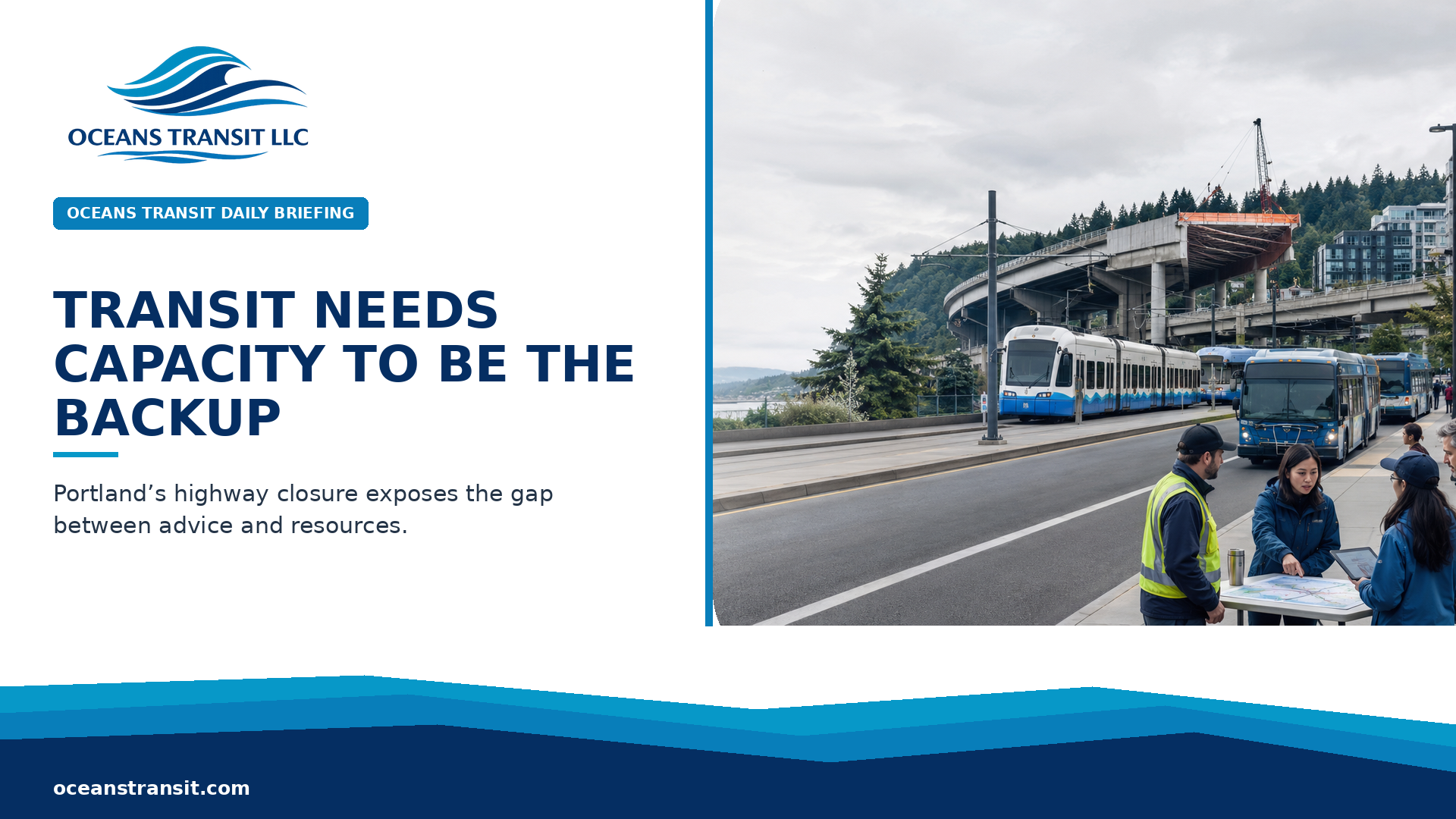
Oregon transportation officials plan to close all southbound lanes of Interstate 5 through Portland’s Rose Quarter around the clock beginning September 11 for up to five weeks. The Oregon Department of Transportation expects significant regional congestion and says travel times could double or triple if normal travel patterns continue.
The public advice includes using alternate routes, changing travel times, working remotely, carpooling and taking public transportation. That is reasonable. It also raises an operational question that applies to major construction projects nationwide: Has transit been given the resources to function as part of the mitigation plan?
TriMet enters this period under substantial financial pressure. On August 23, the agency will change 34 lines and eliminate two routes. TriMet says the package will reduce weekly bus service hours by about 4.3% and weekly MAX service hours by 8.7%. It is also reducing staffing and planning additional service cuts as it addresses a long-term structural deficit.
The I-5 closure and the TriMet reductions were created by different needs and timelines. Placing them together does not prove poor coordination. It does reveal the practical limit of public messaging that asks travelers to shift modes without describing the transit capacity available to receive them.
“Take transit” is not an operating plan
Transit can reduce highway-closure demand only if useful service exists at the right locations and times. That requires enough operators, road supervisors, maintainers, serviceable vehicles and yard capacity. It may also require temporary bus lanes, signal priority, park-and-ride capacity, accessible connections and additional customer-service coverage.
If the system cannot add trips, partners still need to identify where existing capacity is available and where crowding or pass-ups are likely. Employers and event venues need specific guidance about travel windows and routes. Customers need honest expectations about frequency and delay.
The same planning applies to emergencies. Transit is routinely named in evacuation, continuity and incident-management plans. A written role is not the same as deployable capacity.
What should be coordinated
A joint construction-mobility plan should estimate displaced trips by corridor and time period, then compare that demand with scheduled transit capacity after all service changes take effect. The analysis should include operator availability, spare vehicles, maintenance staffing and likely road congestion affecting buses.
Temporary funding responsibilities should be explicit. If a highway project expects transit to absorb additional demand, the project budget or regional partners should evaluate whether they can support supplemental service, bus-priority measures, communications and field supervision.
Accessibility also requires more than a general recommendation. Planners should identify accessible stops, paths and connections; consider paratransit travel-time impacts from congestion; and ensure that temporary information is available in usable formats.
The TriMet implementation lesson
TriMet’s August reductions provide useful planning context. The agency says community feedback changed several proposals, preserving connections to a medical center, school programs and other destinations. That shows why public and frontline input should occur before a final mobility plan is announced.
For the I-5 closure, the strongest next step is a shared readiness briefing from ODOT, TriMet and local partners explaining what service will be available, where capacity is constrained, what priority treatments will be used and how performance will be monitored.
The larger industry lesson is direct: transit can be an effective contingency strategy, but only when transit is treated as an operating partner with defined resources—not as a sentence at the bottom of a highway advisory.
Sources and context
- I-5 Rose Quarter Improvement Project, “Frequently Asked Questions,” accessed August 17, 2026
- Oregon Department of Transportation, “ODOT to Close I-5 Southbound in the Rose Quarter in September,” May 4, 2026
- TriMet, “Service Cuts and Changes—August 2026,” accessed August 17, 2026
- TriMet, “Moves Forward on Streamlining Spending and Resizing Agency,” May 2026