
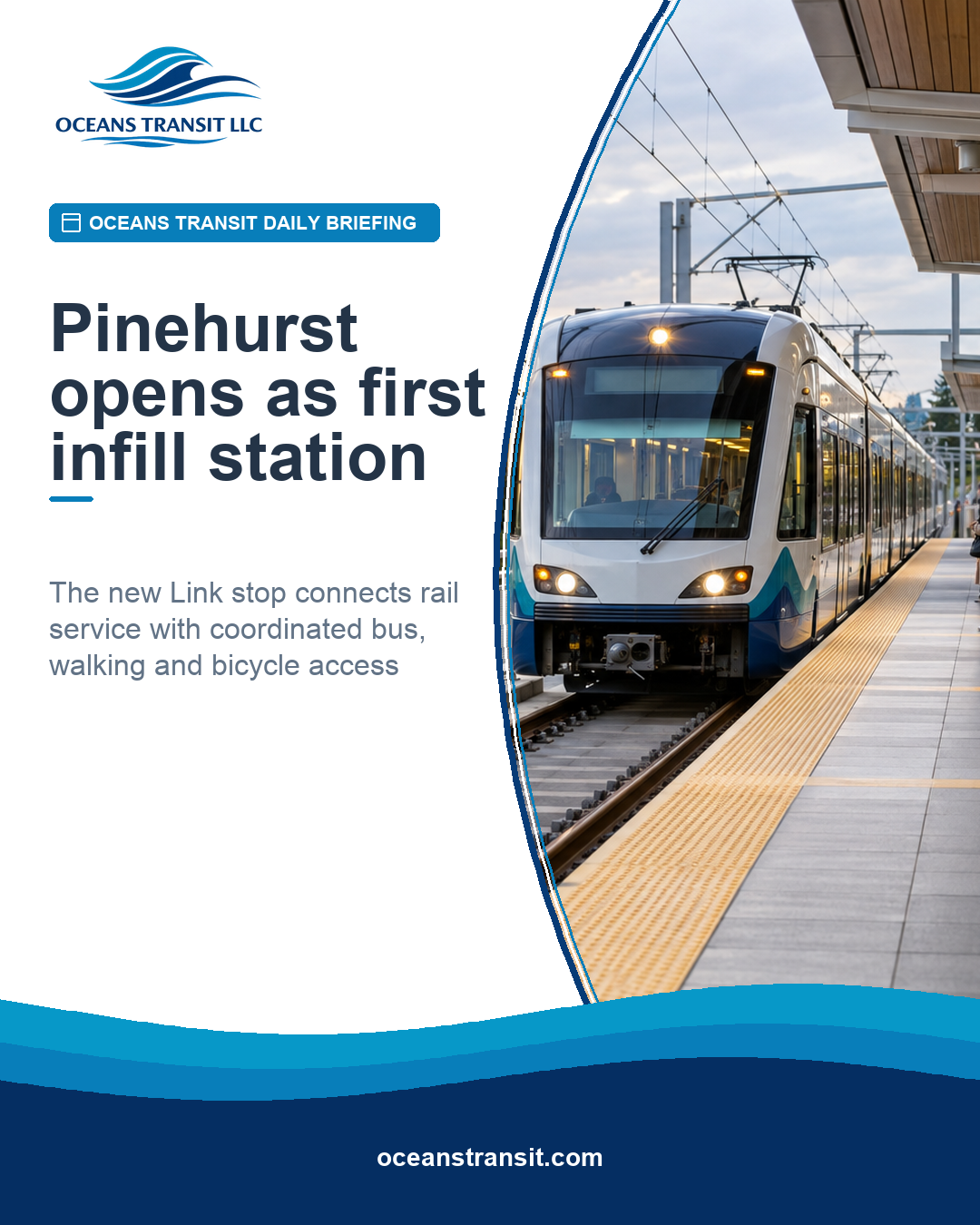
Pinehurst opens as Sound Transit's first infill station
The new North Seattle stop adds a practical case study in building access into an operating rail corridor and coordinating the first and last mile.
Sound Transit opened Pinehurst Station at the start of service on September 30, adding a new stop on the 1 and 2 Lines between Northgate and Shoreline South/148th. The station is the agency's first infill station—one inserted into an already operating rail corridor—and brings frequent rail service to the NE 130th Street area of North Seattle.
According to the agency's opening announcement, trains are scheduled every four to five minutes during the most frequent service periods. Sound Transit expects the station to serve about 3,400 riders over time, while its project page gives a planning range of roughly 2,600 to 4,200 daily boardings. Those figures are forecasts, not opening-day ridership results.
A station added to an active line
An infill station presents a different delivery challenge from a station built as part of a new extension. Designers and contractors must create platforms, vertical circulation, power, communications, safety systems and passenger access around a corridor that already carries service.
Pinehurst was included in the voter-approved Sound Transit 3 plan in 2016 and was originally projected to open in 2031. The Sound Transit Board advanced the station into final design in 2020 and approved additional budget and contract changes in 2022. That allowed early construction to proceed in coordination with the Lynnwood Link work and brought the opening forward by approximately five years.
For transit capital teams, the useful lesson is not simply that an accelerated schedule is possible. The agency aligned the infill project with nearby corridor construction before normal service patterns became fully established. That sequencing reduced the amount of work that otherwise would have taken place beside a mature operating service.
Access planning is part of the operating plan
The station's usefulness depends on more than train frequency. Sound Transit's opening-day information points to coordinated access changes by King County and the City of Seattle. King County Metro introduced Route 77 in August to provide an east-west connection, and Seattle has been improving bus stops, protected bicycle facilities and walking access near NE 130th Street.
The agency says Pinehurst provides direct rail access toward downtown Seattle, Seattle-Tacoma International Airport and communities along both Link lines. The station includes accessible paths to the platforms, and the surrounding improvements are intended to expand the number of people who can reach it without driving.
This is where opening readiness becomes an operations issue. A new station changes stopping patterns, passenger information, operator and control-room routines, wayfinding, emergency response plans, maintenance assignments and bus connections. Agencies opening even a relatively small infill project should rehearse those interfaces together rather than treating the station as a self-contained construction handoff.
What other agencies can take from Pinehurst
- Coordinate construction windows with larger corridor work when possible.
- Treat bus, walking, rolling and bicycle access as part of the station opening, not as later enhancements.
- Update passenger information and emergency procedures across every service that touches the new stop.
- Distinguish forecast ridership from measured performance and establish an after-opening evaluation plan.
- Capture delivery lessons while the project team and operating staff can still explain the decisions behind them.
Sound Transit's current service alert confirms service began September 30. The next meaningful evidence will come from actual ridership, transfers, accessibility performance and operating reliability after passengers incorporate the stop into daily travel.
For Oceans Transit readers, the opening is a reminder that an infill station is not merely a platform placed between two existing stops. It is a system change. The quality of the opening will be measured by how well construction, rail operations, bus service, public information and accessible first-and-last-mile connections work as one network.