
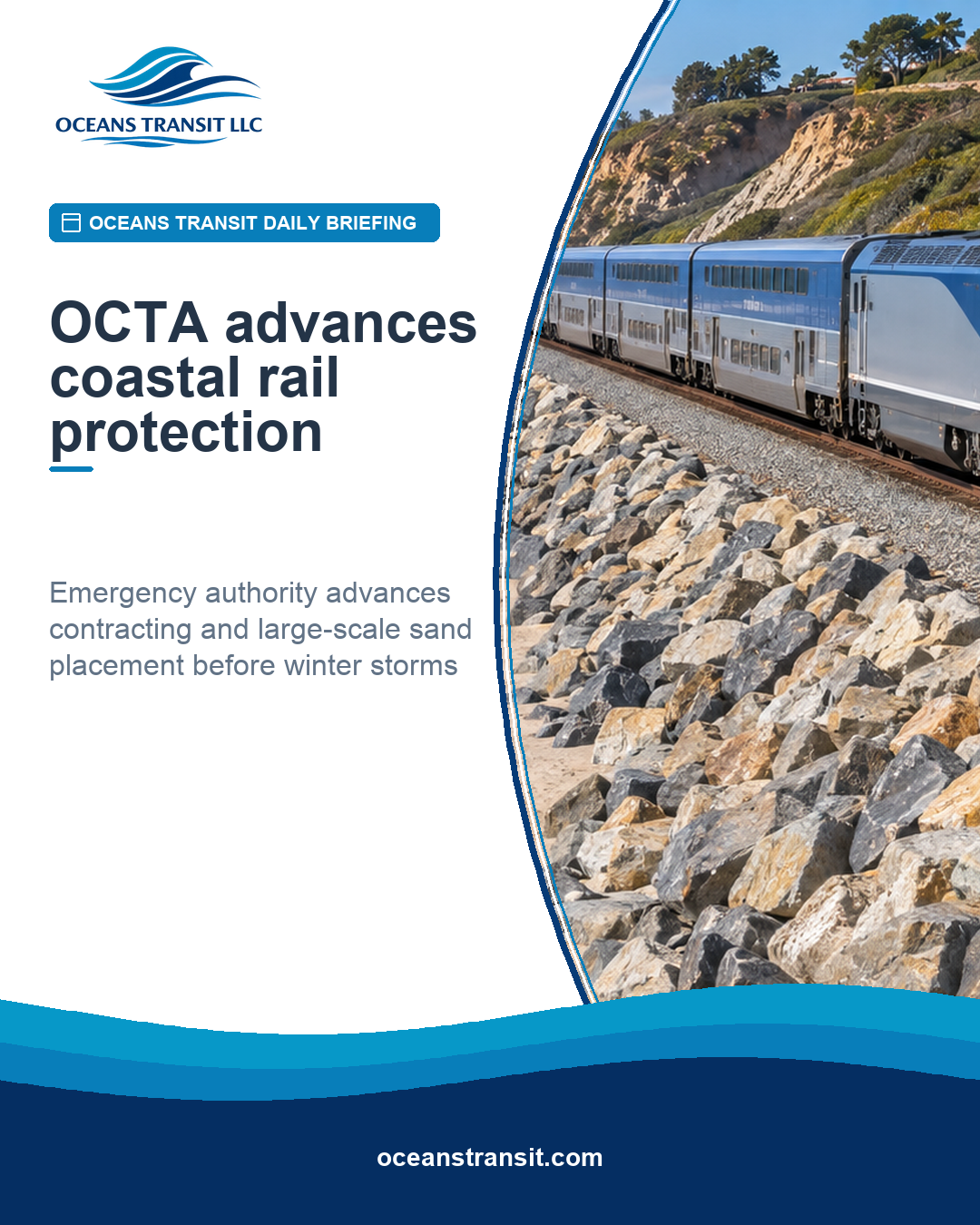
OCTA emergency action accelerates coastal rail protection
The board authorization moves the San Clemente response from immediate stabilization toward accelerated contracting, sand placement and winter readiness.
The Orange County Transportation Authority has declared an emergency along the coastal rail line in San Clemente and authorized its chief executive to accelerate contracting, materials procurement and shoreline-protection work. The September 28 action is a substantive follow-up to the early-September closure covered by Oceans Transit: it sets out a larger protective program before possible El Niño-driven winter storms.
OCTA's official announcement says the agency plans to advance an engineered shoreline-protection structure, repair existing rock protection and place approximately 690,000 cubic yards of sand. About 240,000 cubic yards is planned between North Beach and Mariposa Point, with another 450,000 cubic yards planned south of San Clemente State Beach.
What changed since the closure
The September 8 closure followed waves and high tides that overtopped the tracks and further damaged the adjacent slope and protective rock. The immediate response focused on inspection, repair and stabilization so passenger service could resume safely.
The new board action changes the administrative posture. OCTA's board record authorized Resolution No. 2026-075 and empowered the chief executive to take necessary actions to address the emergency at identified reinforcement areas. That authority is intended to let the agency secure contractors, equipment and suitable sand when they become available instead of waiting through normal procurement timelines.
The emergency declaration does not erase other requirements. OCTA states that environmental review and permitting still apply. The agency must continue coordinating with the California Coastal Commission, the U.S. Army Corps of Engineers and other regulators.
A logistics problem as well as an engineering problem
Moving 690,000 cubic yards of sand to a constrained coastal corridor is not a routine delivery. OCTA has identified Surfside-Sunset as a source of beach-compatible sand, but the railroad sits between bluffs and the ocean with limited land access. Large-scale placement may require marine hopper dredges that can transport sand and pump it ashore.
OCTA says the number of U.S.-qualified dredges capable of this work is limited and that many are committed months in advance. The agency is therefore trying to move design, permitting and contracting in parallel. That approach can shorten the schedule, but it also increases the need for disciplined configuration control, safety coordination and clear decision records.
California's September 21 emergency proclamation directs state agencies to prepare for flooding, landslides and coastal impacts and to support faster permitting where allowed. OCTA's action aligns the rail project with that statewide readiness effort.
The transferable transit lesson
This development offers a broader lesson for agencies responsible for climate-exposed assets. Emergency declarations can create speed, but speed must be paired with controls that preserve safety and accountability.
Transit owners should be ready to document:
- the hazard and the evidence supporting emergency action;
- which procurement steps are accelerated and which legal or environmental requirements remain;
- who has authority to approve design changes and field decisions;
- how passenger, freight and maintenance operations will be protected during work;
- the trigger points for service restriction or closure; and
- how temporary protection connects to a longer-term resilience strategy.
The San Clemente segment is part of the 351-mile Los Angeles-San Diego-San Luis Obispo rail corridor and carries Metrolink, Amtrak Pacific Surfliner, freight and military traffic. OCTA reports more than $300 million in state and federal stabilization funding, but repeated disruptions since 2021 show why a funded project list is not the same as a resilient operating corridor.
As of the September 30 noon research cutoff, contracting, permitting and construction schedules were still developing. OCTA said staff will return to the board with updates. The most important next evidence will be whether permits, dredging capacity and work windows align early enough to place meaningful protection before severe winter conditions—and whether the corridor can maintain safe, reliable service while that work advances.