
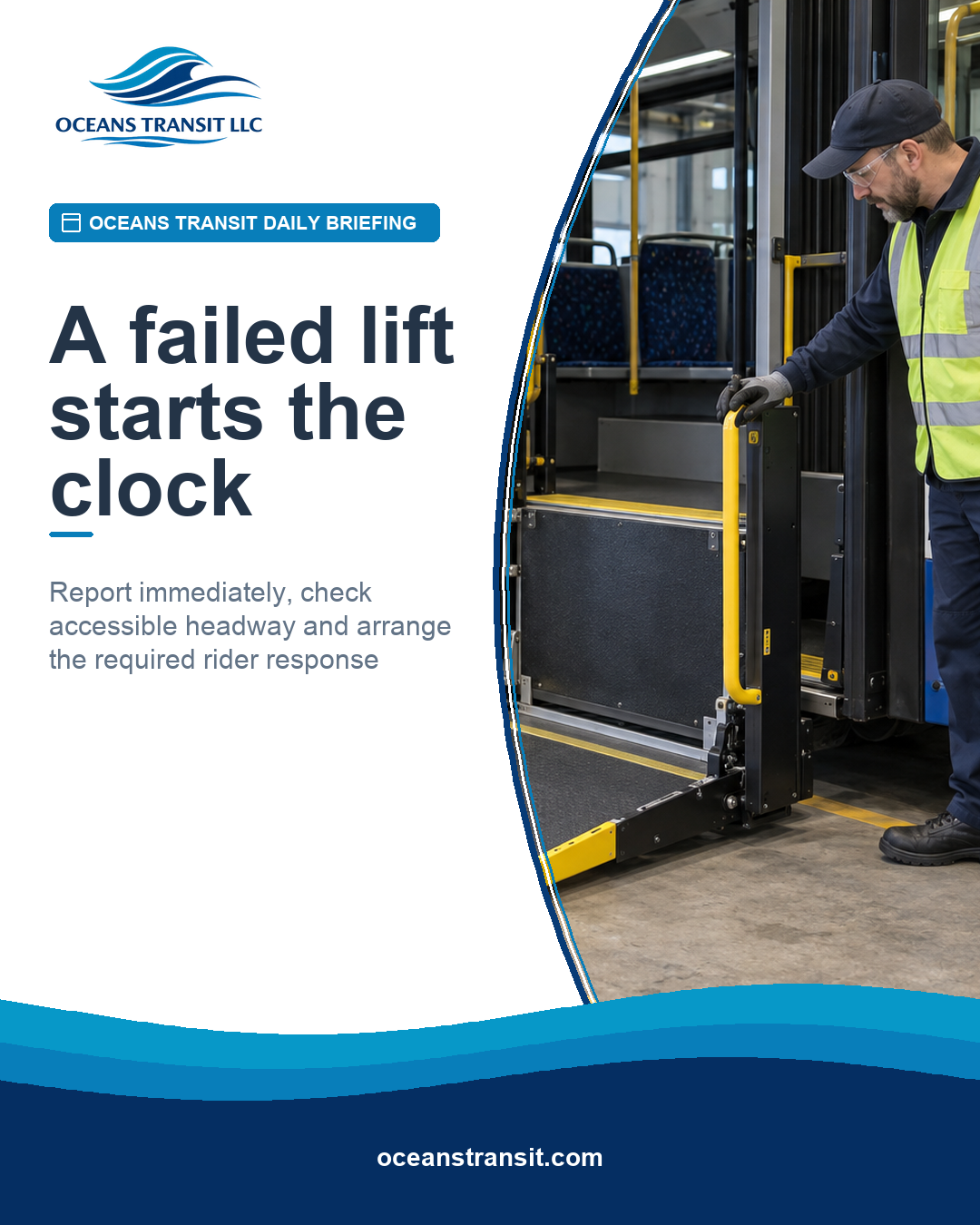
A vehicle operator presses the control and the accessibility lift does not operate. That is not only a maintenance defect for the end-of-shift list. It starts a time-sensitive service decision governed by 49 CFR 37.163.
The rule requires public entities to maintain a system of regular and frequent lift checks sufficient to determine whether lifts work. It also requires operators to report an in-service lift failure by the most immediate means available. What happens next depends on repair, spare-vehicle availability, service-area population and the headway to the next accessible vehicle.
Report now, not at pull-in
Section 37.163(c) says a vehicle operator must report a lift failure by the most immediate means available. For a working operator, that means following the agency's immediate control-center or dispatch procedure—not waiting for a written defect card at the garage.
The first report should allow the agency to act. Oceans Transit recommends that the report identify:
- vehicle and run;
- exact stop or location;
- whether a rider is waiting or already aboard;
- observed lift condition and any operator reset permitted by procedure;
- direction of travel and next accessible service; and
- any immediate roadway, boarding-area or passenger-safety concern.
That content is an Oceans Transit operational recommendation, not prescribed wording in the federal rule. Agencies should use their own approved troubleshooting limits and never encourage an operator to improvise a repair.
Removal and repair are the default
The federal rule says that, when a lift is found inoperative, the public entity must take the vehicle out of service before the beginning of its next service day and repair the lift before returning the vehicle to service. That is the default path.
There is a limited exception when no spare vehicle is available and removing the bus would reduce the transportation service the entity can provide. In that circumstance, a vehicle with an inoperative lift may remain in service for no more than five days if the entity serves 50,000 people or fewer, or three days if it serves more than 50,000 people.
The exception is not a routine grace period. It depends on the absence of a spare and an actual reduction in service. A local record should therefore show the discovery time, immediate report, spare-vehicle check, repair status, service decision and applicable deadline.
The 30-minute threshold changes the rider response
If a fixed-route vehicle is operating with an inoperative lift and the headway to the next accessible vehicle exceeds 30 minutes, section 37.163(f) requires the entity to promptly provide alternative transportation to people who cannot use the vehicle because the lift does not work.
That requirement means dispatch cannot close the call by saying “take the next bus” without checking the accessible headway. The control center needs a reliable way to identify the next accessible trip and arrange the agency's approved alternative when the threshold is exceeded.
The rule does not prescribe one universal alternative-transportation method. Fleet, contractor, road-supervisor and accessible-vehicle resources differ. The agency's procedure should identify who has authority to arrange the ride, what information may be shared, how the rider receives an estimate and how completion is confirmed.
Train a decision sequence
Oceans Transit recommends teaching lift failures as a five-step decision rather than a maintenance fact:
- Report the failure immediately through the approved channel.
- Protect the rider and boarding area while following authorized operating procedures.
- Check spare availability and the next accessible headway.
- Provide prompt alternative transportation when the federal condition applies.
- Record repair, service and rider-response decisions through closure.
An instructor can assess the sequence with a dispatch simulation. Give the learner a route, time, service-area population, spare status and next accessible arrival. The learner should identify the immediate report, default removal rule, whether the limited exception is available and whether alternative transportation is required.
This exercise is Oceans Transit guidance. It does not replace legal review, collective-bargaining provisions, approved maintenance instructions or the agency's ADA procedures.
Connect maintenance readiness to customer access
The regulation also requires regular and frequent maintenance checks. A pre-service test may catch the defect before a rider is affected, but a passing morning test does not end the duty to report a failure that occurs later.
Supervisors should compare lift-failure records across vehicles, routes, time of day and defect types. Repeated failures may indicate a parts, preventive-maintenance, training or fleet-reliability issue that deserves broader corrective action. That analysis is part of a responsible maintenance and Safety Assurance process; the rule itself establishes the accessibility obligations.
A failed lift is a maintenance problem, an operating decision and a rider-access obligation at the same time. The response works only when the operator, dispatcher, maintenance team and customer-service function share the same clock and the same decision path.