
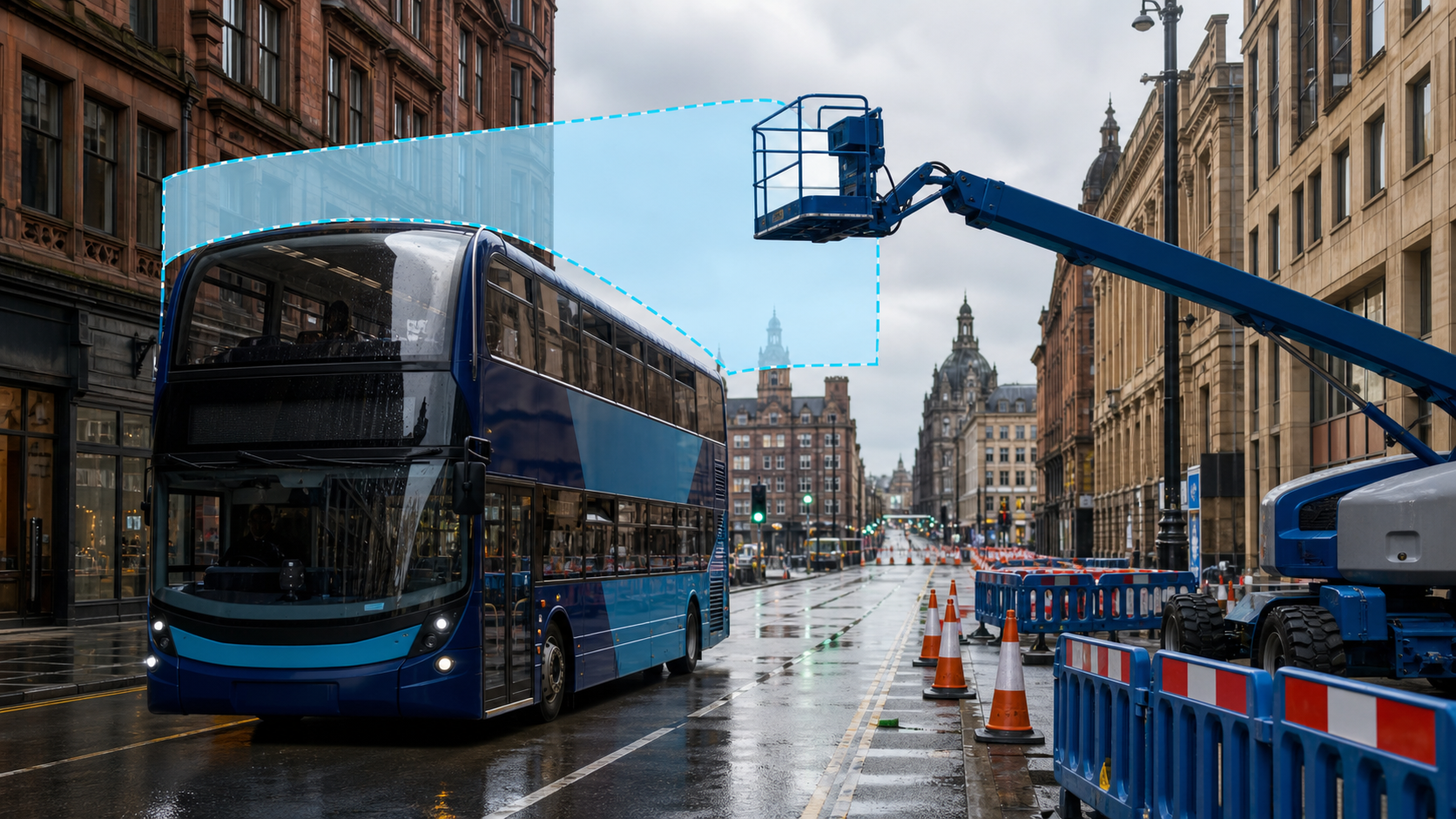
A man was taken to a hospital after a bus struck a cherry picker on Baird Street in Glasgow on August 18. Police Scotland confirmed the basic circumstances through an initial news report, but important details remain unresolved. The bus operator, the injured person’s condition, the equipment position and any contributing factors have not been publicly established.
That uncertainty matters. Oceans Transit is treating this as a developing safety event, not as proof of fault by the operator, contractor or roadway authority. The immediate value is the exposure it reveals: a high-profile vehicle can encounter an obstruction above the driver’s normal sight line even when the path ahead appears open at windshield height.
The precedent changes the training question
Glasgow has experienced a serious event involving the same type of equipment before. In February 2022, a double-decker bus struck the knuckle of a mobile elevated work platform that protruded over Ardencraig Road. A worker was thrown from the basket and suffered severe, permanent injuries.
The Crown Office and Procurator Fiscal Service later reported that the construction company failed to ensure the work was properly planned and that suitable measures were not in place to segregate the equipment from traffic. The company was fined in 2024. Those official findings apply to the 2022 case; they must not be assumed to describe the August 2026 incident.
The earlier case nevertheless establishes why full-envelope clearance deserves explicit attention. Operators make countless safe judgments from the driver’s seat, but mirrors, rooflines and seating position can limit the view of equipment extending over the road above normal traffic height.
What agencies should review now
Transit agencies should verify how temporary roadway hazards are reported, evaluated and communicated before a high-profile vehicle enters the area. Route supervisors need a way to identify the complete vehicle envelope—not only lane width and windshield-level clearance—when construction equipment, tree work, scaffolding or temporary utilities are present.
Operator training should reinforce a simple decision rule: if the upper envelope cannot be confirmed, stop short and request assistance. That guidance must be supported by dispatch and supervision so operators are not pressured to make an uncertain clearance judgment while traffic builds behind them.
Municipal permitting offices, contractors and roadway authorities also need reliable coordination procedures. A permit or traffic-control drawing does not protect a bus if the field setup changes, equipment slews into the roadway or warning devices fail to communicate the actual hazard.
The next responsible update
The fuller safety assessment should wait for official information identifying the vehicle, work-zone arrangement, equipment position, injuries and investigative findings. Until then, the practical lesson is limited but useful: the driver’s view is not the vehicle’s full clearance envelope, and temporary work zones must be planned for the tallest and widest vehicles expected to use the street.