
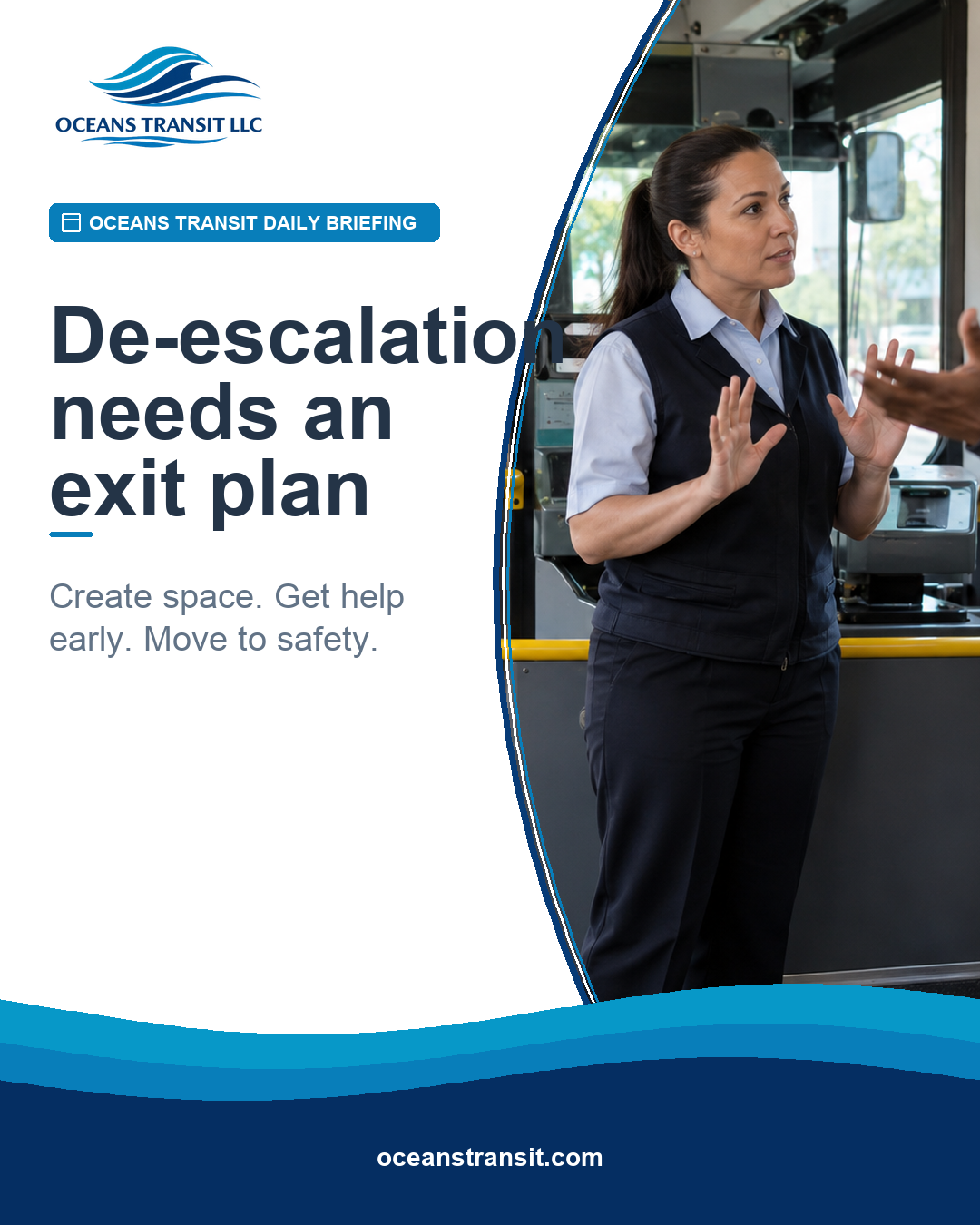
De-escalation is often taught as a set of words: speak calmly, listen and avoid confrontation. Those skills matter, but words alone are not a safety system.
The Federal Transit Administration's De-Escalation Training Resource Directory describes de-escalation as one component of a multi-faceted Safety Management System. FTA points to other controls such as mirrors, signage, cameras and coordination with law enforcement. Its materials support agencies in developing and updating training while cautioning that inclusion in the directory is technical assistance, not federal endorsement of every resource.
That distinction is important. An operator should never be trained to believe that the right phrase can control every person or situation.
The Oceans Transit safety tip: CALM
Use four reminders: create space, ask and listen, limit choices, move to safety.
Create space
Maintain reaction distance when conditions allow. Avoid crowding the person, blocking the exit or allowing yourself to be trapped against the farebox, operator barrier or a fixed object. Keep your hands visible and your posture neutral.
Ask and listen
Use a short question to identify the immediate issue: “What do you need right now?” Listening does not mean agreeing with threats or abuse. It helps separate a solvable service problem from behavior that requires assistance.
Limit choices
Offer one or two realistic options that you are authorized to provide. Too many explanations can sound like an argument. A clear boundary works better: “I can help you with these two choices.” Do not promise an outcome the agency cannot deliver.
Move to safety
Know the trigger for calling dispatch, requesting a supervisor, activating an emergency procedure or leaving the immediate area. If the person displays a weapon, attempts physical contact, blocks movement or makes a credible threat, follow agency emergency procedures. De-escalation is not a requirement to remain in danger.
Train the environment, not just the employee
Agencies should practice the complete response system:
- how the operator contacts dispatch without escalating the encounter;
- what information dispatch needs first;
- where a supervisor or security resource will respond;
- how nearby passengers receive clear direction;
- when service should stop or the vehicle should remain in place; and
- how the event is documented and reviewed afterward.
This approach aligns with FTA's description of de-escalation as part of SMS. Training is stronger when it is supported by equipment, policy, communications and management follow-through.
Build scenarios around decisions
A useful exercise is not “calm down an angry passenger.” That goal is outside the employee's control. A stronger exercise asks the learner to:
- recognize an escalation cue;
- establish safe distance and position;
- use one neutral opening statement;
- offer an authorized option;
- request help at the defined trigger; and
- disengage according to agency procedure.
Assess the decisions, not whether the role-player becomes cooperative. A learner can make every correct safety decision and still face a person who continues to escalate.
After the event
Post-event work should include immediate care, required reporting, preservation of evidence and a review of what controls worked or failed. The question is not only “What did the operator say?” It is also whether communications functioned, assistance arrived, the workspace supported escape and prior reports had identified the same hazard.
De-escalation is valuable because it gives employees options before a situation becomes violent. It is responsible only when training also gives them permission and a practiced method to get help and move to safety.