
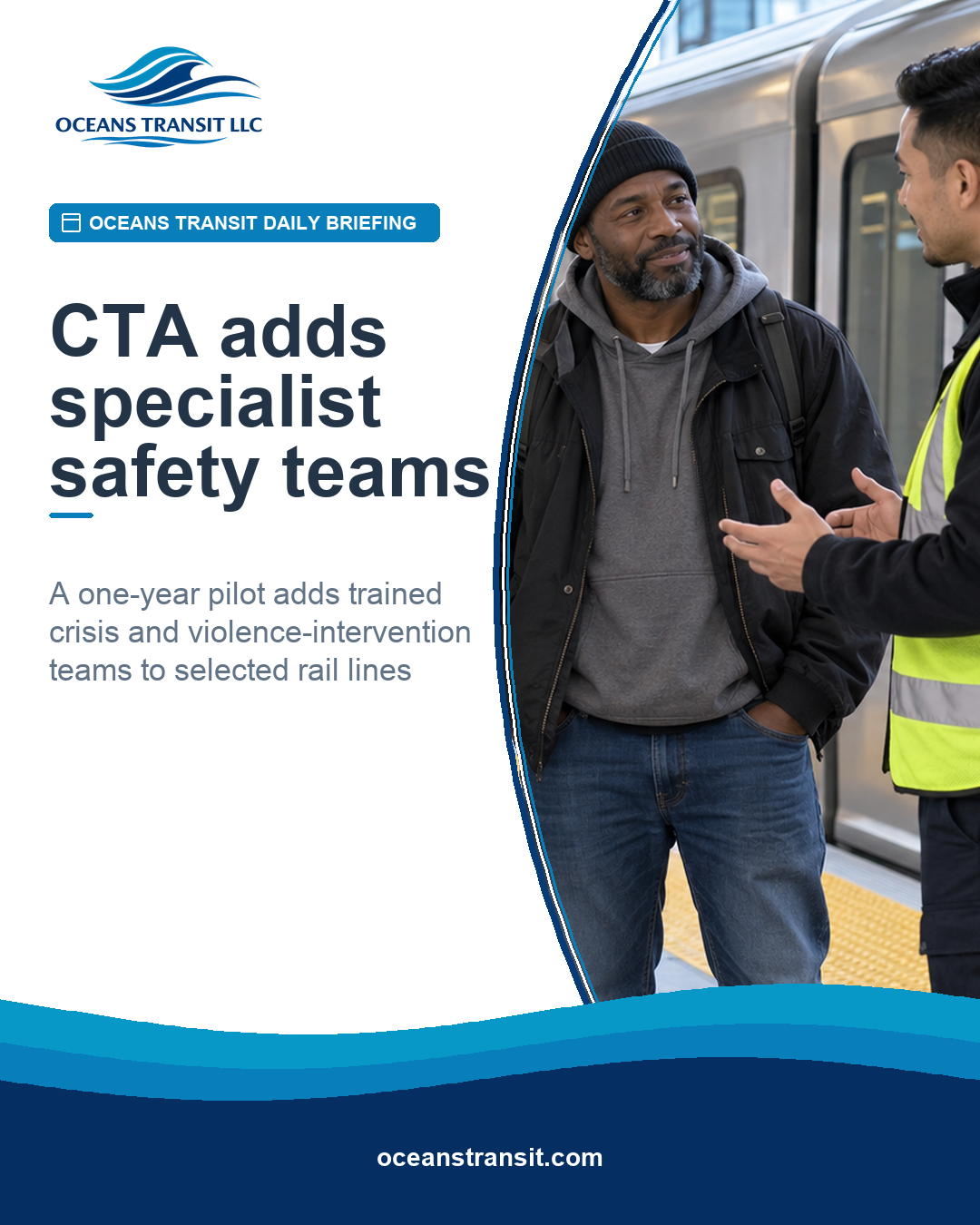
The Chicago Transit Authority (CTA) has launched a one-year Safe Ride Specialist pilot that places trained, non-law-enforcement teams on selected Red, Blue and Green Line segments. The October 21 announcement matters beyond Chicago because it defines a distinct transit-safety role: specialists are meant to address some behavioral-health and conflict situations before they escalate, while coordinating with police, security personnel and frontline staff rather than replacing them.
Two specialist functions
According to CTA's announcement, the teams include mental-health clinicians, peer-support specialists, crisis-intervention specialists and community-violence-intervention experts.
- Crisis Intervention Specialists connect riders experiencing housing instability, mental-health crises or substance-use disorders with treatment, housing and social services.
- Community Violence Intervention Specialists engage young people and young adults, seek to de-escalate conflicts and redirect behavior before it becomes more serious.
CTA says the teams wear identifiable vests and operate from targeted staging areas on the three rail lines. The program page lists specific locations and operating hours and says deployment was informed by incident data plus rider and employee feedback.
A pilot with measurable questions
CTA reports a total pilot cost of $9.6 million. The agency says it will measure incidents de-escalated without law enforcement, service-delay reduction, improved safety for riders and frontline personnel, and connections to wraparound services.
Those are useful categories, but the announcement does not provide baselines, target values or the detailed measurement method. The responsible conclusion is that CTA has defined a test—not that the approach has already succeeded.
The transferable operating lesson
For another transit agency, the first question is whether it can define the handoff among operators, control centers, specialists, security, police and emergency medical services.
- Set dispatch criteria and emergency thresholds.
- Give frontline workers a simple request path without assigning clinical diagnosis.
- Train all roles on personal safety, scene boundaries and escalation.
- Confirm referral partners have capacity.
- Measure safety, service, connections and unintended consequences.
FTA's Safety Management System framework requires agencies to identify hazards, assess safety risk and monitor whether mitigations work. It does not require CTA's staffing model. Transit leaders should watch the evaluation for evidence about use, resolution, referrals and frontline-worker experience.