
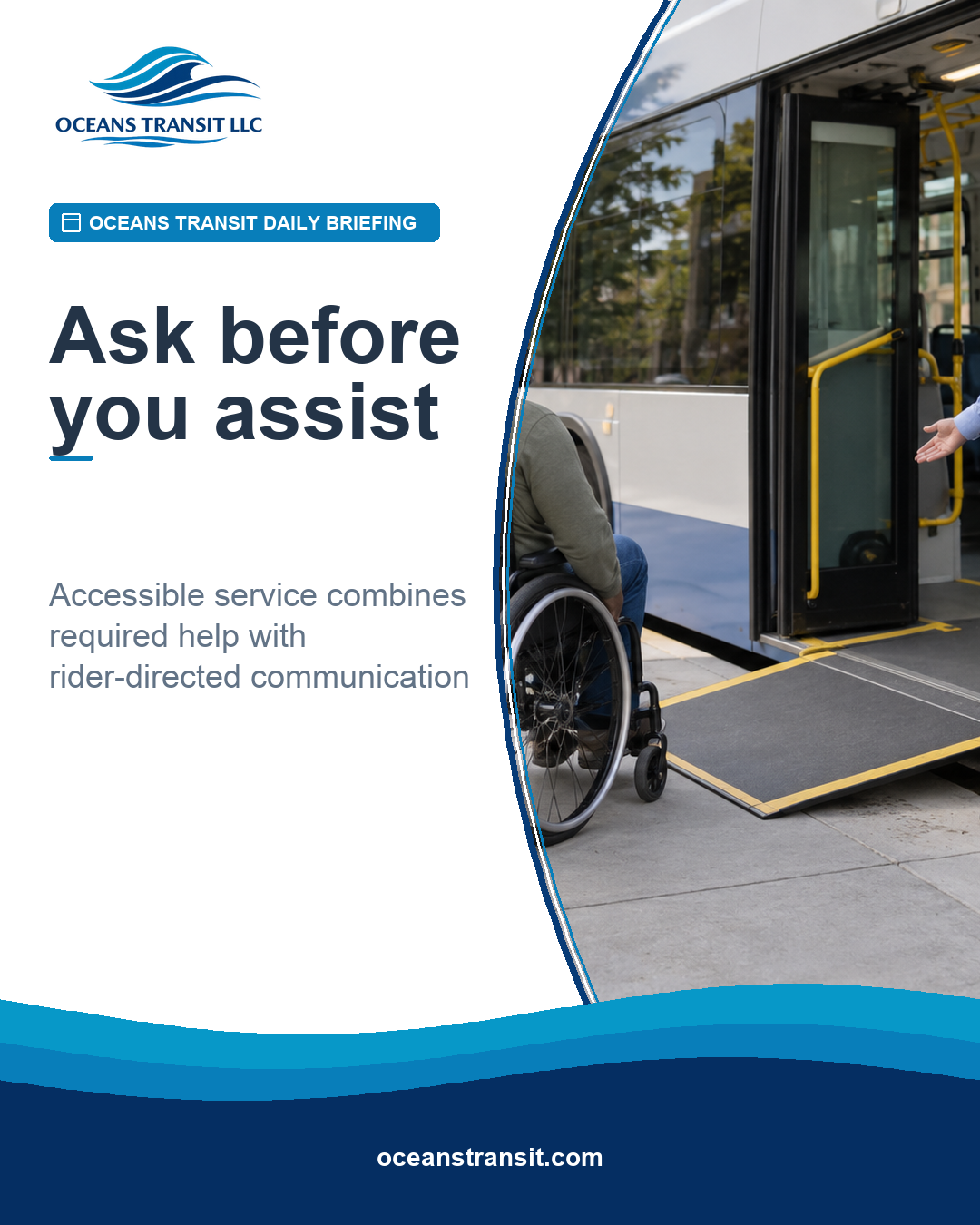
Transit employees are often trained to be helpful. Accessibility requires something more precise: provide required assistance without assuming that every rider wants the same help or uses equipment the same way.
Under the U.S. Department of Transportation's Americans with Disabilities Act regulations, transit personnel must assist individuals with disabilities with ramps, lifts and securement systems when necessary or requested. The regulation says employees must leave their seats when that is required to provide the assistance. It also says an operator may not require a wheelchair user to transfer to a vehicle seat.
Those are federal requirements. The conversation that makes them work is a service skill.
The Oceans Transit practice: ask, prepare, assist, confirm
- Ask: Use a direct, neutral question: “How can I best assist you with boarding?” Do not touch a person or mobility device without permission unless an immediate emergency requires action.
- Prepare: Position the vehicle, clear the boarding area and deploy the accessibility feature according to the agency's procedure. Tell the rider what will happen next when that information is useful.
- Assist: Provide the requested or necessary help with the ramp, lift or securement system. Follow vehicle-specific instructions and the agency's securement policy.
- Confirm: Before movement, ask whether the rider is ready and complete the operator's required safety check.
This four-step practice is Oceans Transit guidance. It does not replace the ADA regulation, an agency's policy or equipment instructions.
Know the securement boundary
DOT rules allow a transit agency to adopt a policy requiring wheelchairs to be secured on vehicles equipped for securement. If securement is required, or if the rider requests it, personnel must use their best efforts to secure the device.
But the regulation also says transportation may not be denied merely because the vehicle's system cannot satisfactorily secure a particular wheelchair. A rider may choose to transfer to an available vehicle seat; the operator may recommend a transfer but may not require it.
Those distinctions belong in training. A simple slogan such as “all chairs must be tied down” can become inaccurate when it omits agency policy, best-efforts obligations and the rule against denying a rider solely because a device cannot be satisfactorily secured.
Train the conversation with the equipment
FTA's Part 37 training standard calls for employees to be trained to proficiency as appropriate to their duties. That includes accessibility equipment, boarding assistance, securement and sensitive interaction with passengers with disabilities.
An instructor can assess both the technical and human parts in one scenario:
- Did the employee ask before acting?
- Was the ramp or lift deployed correctly?
- Did the employee explain or confirm the next step without speaking down to the rider?
- Was assistance consistent with agency policy and the rider's request?
- Did the employee confirm readiness before movement?
The performance standard is not friendliness alone. It is competent assistance that preserves safety, dignity and the rider's control over the interaction.
One clear question prevents a surprising number of mistakes: How can I best assist you?